

Men's vs. Women's Concealer: Key Differences Explained
TL;DR:
- Men’s concealers are formulated for oil control, matte finish, and camouflage, matching skin tone precisely. Women’s concealers focus on enhancement, brightening, and dewy finishes, often designed for different skin types. The core formulas are similar, but marketing distinguishes them through packaging and terminology to fit cultural perceptions.
The difference between men’s and women’s concealer comes down to three things: formulation, finish, and intent. Men’s concealers are built for camouflage, matching skin tone exactly with matte, oil-controlling formulas. Women’s concealers often prioritize enhancement, color correction, and a broader range of finishes. The gap between them is smaller than most people assume, but the distinctions that do exist matter when you want results that look natural. Norml4men was built on exactly this insight: men need a product designed around their skin, not a relabeled version of something else.
What is the difference between men’s and women’s concealer?
Men’s and women’s concealers share the same core function: covering imperfections. The real differences show up in formula composition, finish type, and the skin characteristics each product is designed to work with.
Men’s skin is typically thicker, oilier, and has larger pores than women’s skin. That biological reality drives formulation decisions. A concealer built for oily, thick skin needs stronger oil control and a matte finish to stay in place and look natural throughout the day.
Women’s concealers, by contrast, often include brightening agents, light-reflecting particles, or dewy finishes. Those features work well on drier or thinner skin types but create an unnatural sheen on male skin. A man applying a brightening formula under his eyes often ends up looking like he’s wearing something obvious, which defeats the entire purpose.
The ingredient overlap between men’s and women’s concealers is significant. Many formulas are nearly identical at the chemical level. The differences that matter most are finish (matte vs. dewy), pigment density, and whether the formula includes shimmer or brightening compounds.
How does men’s skin change what goes into the formula?
Male skin produces more sebum than female skin. That means concealers for men need to control oil actively, not just sit on top of it. Formulas that work for men typically use oil-absorbing ingredients like silica or kaolin clay to keep coverage intact for hours.

Men’s concealers avoid shimmery or brightening agents common in women’s versions. Shimmer catches light and draws attention to the skin, which is the opposite of what most men want. A matte finish blends into the skin’s natural texture and stays undetectable.
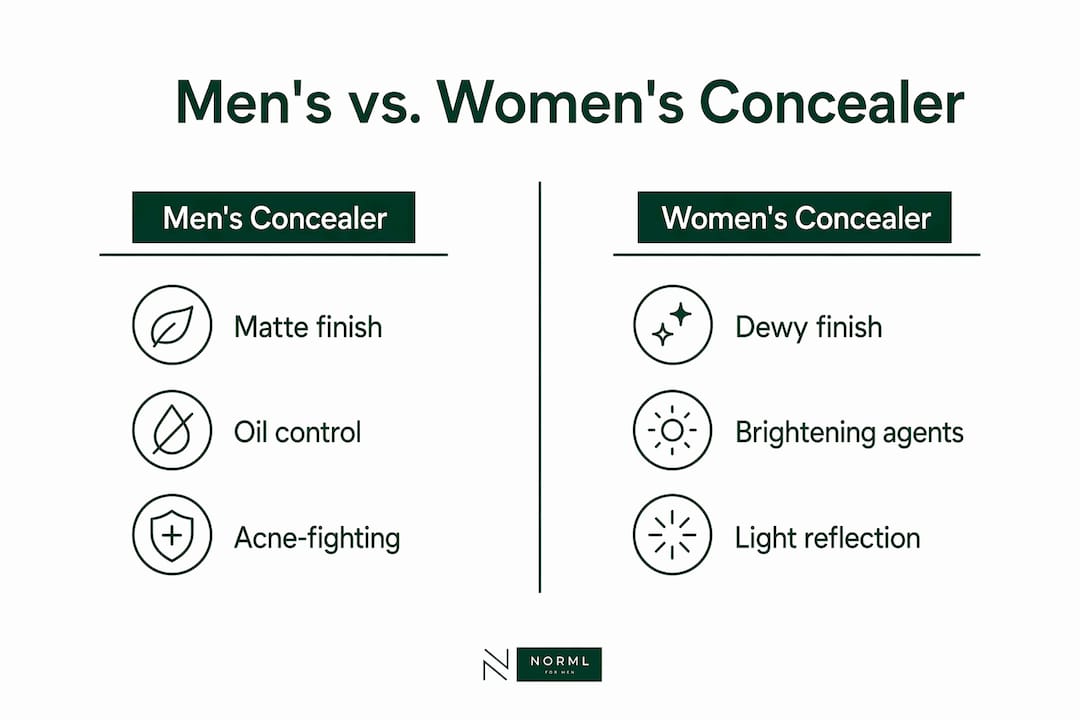
Some men’s concealers go further by including acne-fighting ingredients like salicylic acid. That dual function, covering a blemish while treating it, reflects a practical priority in men’s grooming. Women’s concealers rarely emphasize this because the marketing focus sits elsewhere.
Shade range also differs in practice. Products built for men tend to offer shades across a wide range of skin tones while keeping each shade true to natural skin color. Women’s products sometimes include shades one or two tones lighter for brightening purposes, which creates a different visual effect than straight camouflage.
Pro Tip: Choose a concealer with a matte finish and oil-absorbing ingredients if your skin runs oily. Dewy or luminous formulas will look unnatural on most men within a few hours.
How do application techniques differ between men and women?
The goal of application separates men’s and women’s concealer use more than any formula difference. Men use concealer to camouflage. Women often use it to transform, brighten, or contour. Those different goals require different techniques.
Men and women use the same core application method: dot, tap, and blend. The difference is where and how much. Men apply concealer only to specific trouble spots, blemishes, redness, or dark circles, and blend outward just enough to make the edges disappear. The goal is an undetectable finish, not a noticeable change.
Women sometimes apply concealer across larger areas, using it under the eyes in a triangle shape to brighten the face, or along the jawline for contouring. Those techniques require lighter shades and blending tools like sponges or larger brushes. They work for enhancement but look wrong when men apply them without adjusting for their skin tone and finish.
The most common mistakes men make when applying concealer follow a predictable pattern:
- Using too much product. A small dot covers most blemishes. Excess product sits on top of skin and looks cakey.
- Applying a shade too light. Lighter shades brighten. Men need an exact skin tone match for camouflage.
- Blending over too large an area. Spreading concealer beyond the problem spot dilutes coverage and creates an uneven patch.
- Using a brightening formula under the eyes. Applying concealer as a brightener creates an unnatural effect on men. Match the skin tone exactly, even under the eyes.
- Skipping the blend step. Dabbing without blending leaves hard edges that are visible in natural light.
Pro Tip: Use your fingertip or a small pointed brush to apply concealer. Body heat from your fingertip helps the product melt into skin more naturally than a large brush.
The dot, tap, blend technique works for men when applied with restraint. Less product, exact shade match, and targeted placement produce results that no one notices. That invisibility is the benchmark.
Why does marketing shape how men and women see concealer?
The formula gap between men’s and women’s concealers is often smaller than the marketing gap. Men’s products are rebranded with terms like “spot corrector” and “skin perfector” instead of “concealer” or “makeup.” The language shift is deliberate. It removes the psychological barrier that stops many men from picking up a product they would otherwise find useful.
Packaging follows the same logic. Men’s concealers come in matte, dark, or neutral containers. Women’s products use brighter colors, glossy finishes, and language centered on beauty and enhancement. The visual difference signals who the product is for before anyone reads the label.
| Marketing element | Men’s concealer | Women’s concealer |
|---|---|---|
| Product label | Spot corrector, skin perfector, grooming essential | Concealer, brightener, color corrector |
| Packaging finish | Matte, dark, minimal | Glossy, colorful, decorative |
| Key benefit claim | Camouflage, coverage, natural finish | Brightening, correction, enhancement |
| Formula emphasis | Oil control, matte, skin tone match | Dewy, luminous, color-correcting |
| Target outcome | Undetectable | Visible improvement |
Industry nomenclature labels men’s products as grooming essentials, not makeup. That framing reinforces gender comfort zones even when the formulas are nearly identical. The distinction is cultural rather than chemical.
The men’s grooming market is one of the fastest growing sectors in beauty. Tinted moisturizers and color correctors are becoming standard in men’s grooming routines. That shift reflects a broader cultural move toward normalized male cosmetic use, and brands are responding with products that meet men where they are without requiring them to cross a perceived social line.
Understanding this marketing dynamic helps you choose products with confidence. The label “grooming” does not mean the product is less effective. It means the brand engineered the experience, including the packaging and language, to fit how men think about their skin.
How to choose the right concealer for your skin and goals
Choosing the right concealer starts with identifying what you need to cover and what your skin does naturally. The wrong formula for your skin type produces worse results than no concealer at all.
Work through these factors before buying:
- Identify your problem area. Blemishes, redness, and dark circles each respond differently to coverage. A full-coverage formula works for blemishes. A lighter, skin-tone-matched formula handles dark circles without looking heavy.
- Match your shade exactly. Men should pick a concealer shade that matches their skin tone precisely. Going lighter creates a brightening effect that looks unnatural.
- Choose matte over dewy. Oily or combination skin needs a matte formula. Dewy formulas break down faster and draw attention to pores.
- Check for active ingredients. If blemishes are your main concern, look for salicylic acid in the formula. It treats the skin while covering it.
- Start with minimal product. Build coverage in thin layers. One small dot is almost always enough for a single blemish.
- Test on a less visible area first. Apply a small amount to your jawline or neck before using it on your face. This confirms the shade match in natural light.
The concealer terms used on product labels, full coverage, buildable, skin-tone-match, can be confusing without context. Learning what they mean before you shop saves time and prevents a bad purchase.
Key Takeaways
Men’s and women’s concealers differ most in finish, formula priorities, and application intent, not in their core chemistry.
| Point | Details |
|---|---|
| Formula differences | Men’s formulas prioritize oil control and matte finish; women’s often include brightening agents. |
| Application intent | Men use concealer for camouflage; women often use it for brightening or contouring. |
| Shade matching | Men should match skin tone exactly; a lighter shade creates an unnatural brightening effect. |
| Marketing vs. chemistry | Labels like “spot corrector” are strategic rebranding; the underlying formulas are often nearly identical. |
| Technique matters | Dot, tap, and blend applied with restraint produces an undetectable finish for men. |
The real divide is smaller than the industry suggests
The concealer category has been split by marketing more than by science. I’ve watched men avoid products that would genuinely help them because the label said “concealer” instead of “skin corrector.” That hesitation costs them nothing except the confidence they could have had.
What I find more interesting is how quickly that hesitation disappears once a man tries a product built for his skin and sees the result. The matte finish, the exact shade match, the fact that no one notices anything. That experience changes the conversation entirely. It stops being about whether men “should” use concealer and starts being about which one works best.
The practical lesson I’d offer is this: ignore the gender label on the packaging and focus on the formula. Matte finish, oil control, skin-tone-matched pigment. Those three criteria will serve you better than any marketing category. If a product meets them, it works for you regardless of how it’s labeled.
The cultural shift is already underway. The men’s grooming market is growing because men are realizing that looking sharp is not complicated. One product, applied correctly, handles most of what they want to fix. The stigma around it is dissolving faster than most people realize.
— Ford
Norml4men: built for men who want results, not a routine
Norml4men exists because most concealers on the market were not designed with men’s skin in mind. The formula is matte, lightweight, and matched to real skin tones so it disappears on contact.

If you want to see exactly how to apply it for a natural finish, the how-to guide walks through the full process step by step. You can also read about applying concealer naturally to avoid the most common mistakes men make. Norml4men is a single product that covers blemishes, redness, and dark circles without anyone knowing you’re wearing anything. That’s the point.
FAQ
What is men’s concealer, exactly?
Men’s concealer is a skin-tone-matched, typically matte formula designed to cover blemishes, redness, and dark circles without visible coverage. It differs from standard concealer in its oil-controlling finish and absence of brightening or shimmer agents.
Can men use women’s concealer?
Men can use women’s concealer, but formulas with brightening agents or dewy finishes often look unnatural on male skin. A matte, skin-tone-matched formula produces better results for most men.
How do I match concealer to my skin tone?
Test the concealer on your jawline or neck in natural light. The right shade disappears into your skin without looking lighter or darker than the surrounding area.
Why do men’s concealers avoid the word “makeup”?
Men’s products use terms like “spot corrector” to remove the psychological barrier many men associate with makeup. The rebranding is strategic, not a sign of a different formula.
What is the best application technique for men?
Apply a small dot directly to the problem area, tap gently with a fingertip to warm the product, then blend outward with light strokes. Keep the application targeted and use as little product as possible for an undetectable finish.


