

10 Proven Ways to Boost Men's Confidence Fast
TL;DR:
- Confidence in men develops most effectively through repeated mastery of specific behaviors that generate evidence of competence.
- Practicing small, domain-specific challenges, engaging in exposure with reevaluation, and maintaining self-compassion are key to building lasting confidence.
Confidence is defined in psychology as self-efficacy: your belief in your ability to execute specific behaviors and achieve specific outcomes. The most effective ways to boost men’s confidence are not generic pep talks or mirror affirmations. They are concrete, behavior-linked actions that generate real proof of competence. Research from Albert Bandura’s Social Cognitive Theory confirms that task-specific mastery drives lasting confidence gains far more reliably than mindset shifts alone. This article breaks down ten research-backed strategies, from exposure-based practice and self-compassion to grooming routines, that build self-esteem for men in social and professional settings.
1. Ways to boost men’s confidence through mastery experiences
Confidence grows when you complete real tasks successfully, not when you tell yourself you can. Repeated task completion produces measurable self-efficacy gains, while generic affirmations produce almost none. This is the single most important principle in any confidence building technique worth your time.
The key is specificity. Broad goals like “be more confident” give your brain nothing to track. Instead, set micro-goals tied to concrete behaviors:
- Speak up once in the next team meeting
- Start one conversation with a stranger this week
- Present your idea before someone else fills the silence
Each completed micro-goal creates a proof point. Over time, those proof points stack into a durable sense of competence that holds up under pressure.
Pro Tip: Keep a confidence journal. After each micro-goal, write down what you did, how it felt before versus after, and what the actual outcome was. This practice makes your progress visible and gives you evidence to draw on when doubt creeps in.
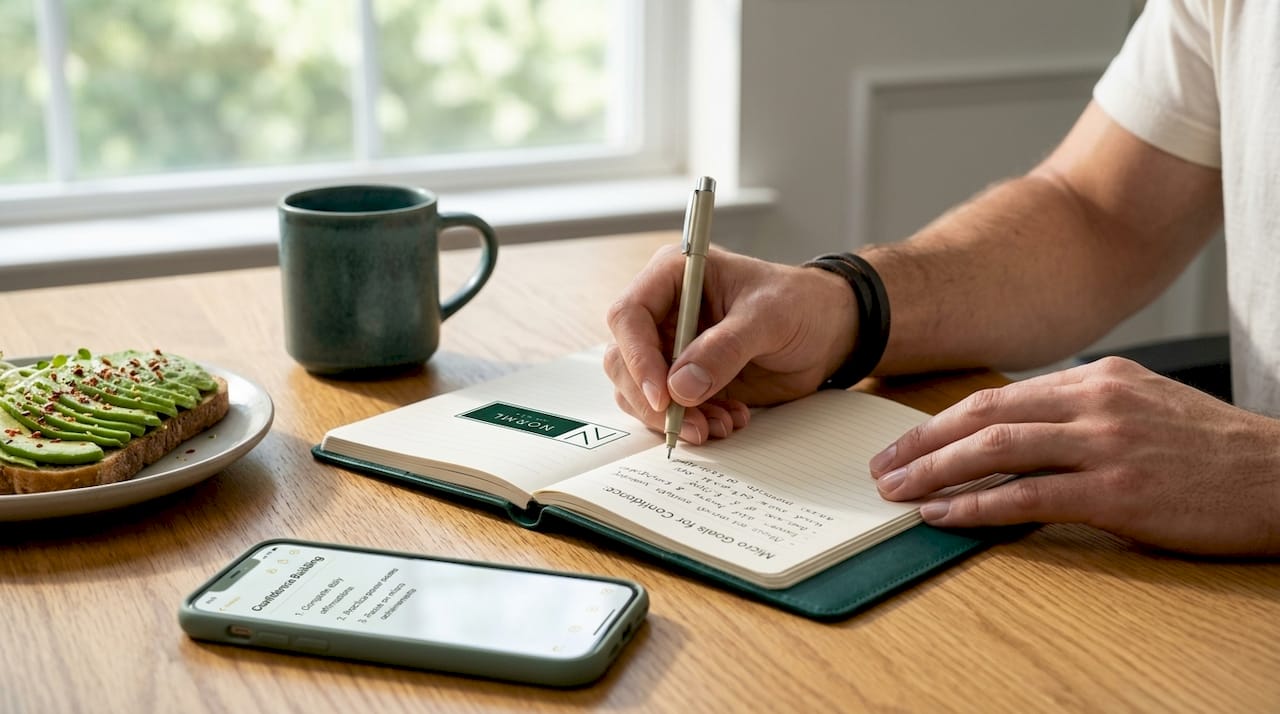
2. How mastering small challenges builds your self-efficacy
Self-efficacy is context-dependent by design. The confidence you build at the gym does not automatically transfer to a job interview. This is why men’s confidence tips that focus on one area often fail to produce results in another.
The fix is deliberate practice across the specific domains where you want more confidence. If social settings are the challenge, practice social behaviors. If professional settings are the issue, practice professional behaviors. Confidence scales should match the behavioral domain you are targeting, or you will not detect real progress.
Start with the lowest-difficulty version of the behavior. Then increase the challenge incrementally. A man who wants more confidence in meetings might start by asking one clarifying question per meeting, then graduate to offering one opinion, then to presenting a short update. Each step builds on the last.
3. How exposure to social challenges accelerates confidence
Exposure-based cognitive behavioral therapy (CBT) is the most evidence-backed method for reducing social anxiety and building social confidence fast. A 2026 RCT using videoconference CBT delivered in a 12-hour, 2-day format produced significant reductions in social anxiety and fear of negative evaluation. The speed of those results matters. You do not need months of therapy to see movement.
The mechanism is straightforward. You enter a situation that triggers mild to moderate anxiety, you stay in it long enough to re-evaluate the outcome, and you update your prediction. Most feared outcomes do not happen. When they do not, your brain recalibrates.
Here is a practical exposure sequence you can run on your own:
- List five social situations you currently avoid or find uncomfortable
- Rank them from least to most anxiety-provoking
- Start with the lowest-ranked situation and engage with it deliberately
- After the interaction, rate the actual outcome versus your prediction
- Move up the list only when the current level feels manageable
Pro Tip: The goal is not to eliminate anxiety before acting. The goal is to act while anxious and then re-evaluate. Behavioral experiments that include cognitive restructuring after the fact produce faster confidence gains than exposure alone.
4. How self-compassion sustains long-term confidence gains
Self-compassion is not softness. It is a psychological resilience mechanism that buffers the emotional damage of setbacks, keeping your confidence intact when things go wrong. A 2026 RCT on self-compassion found that a targeted web-based self-compassion intervention maintained stress reduction at a 3-month follow-up, while broader mindfulness programs did not. That durability is the point.
When you fail at a task or embarrass yourself socially, the default male response is often harsh self-criticism. That criticism amplifies distress and makes you less likely to try again. Self-compassion interrupts that cycle. It does not mean lowering your standards. It means treating a setback the way a good coach would: acknowledge it, learn from it, and move forward.
Simple daily practices that build this capacity:
- Write one sentence each evening acknowledging something that was hard today without judging yourself for it
- When you catch harsh self-talk, ask: “Would I say this to a friend in the same situation?”
- Use apps like Waking Up or Insight Timer for short guided self-compassion exercises
Pair self-compassion with gratitude. Noting three specific things that went well each day trains your attention toward evidence of competence, which reinforces the mastery loop described earlier.
5. How grooming and appearance contribute to male confidence
Appearance-related self-efficacy is real and measurable. When you feel good about how you look, you carry yourself differently. You make more eye contact, speak more clearly, and project more authority. Grooming routines are not vanity. They are a practical confidence building technique with compounding social returns.
The table below shows how different grooming investments map to confidence outcomes in social and professional settings:
| Grooming habit | Confidence impact |
|---|---|
| Consistent skincare routine | Reduces self-consciousness about skin, improves eye contact |
| Covering blemishes or redness | Lowers appearance-related anxiety before high-stakes interactions |
| Well-fitted clothing | Signals competence and improves posture |
| Regular haircut | Creates a sense of control and readiness |
Men’s beauty products have moved well beyond basic moisturizer. Subtle coverage products designed specifically for men now let you address dark circles, redness, or uneven skin tone without anyone knowing you are wearing anything. The result is a version of yourself that looks sharp and rested, which directly feeds the self-perception loop that drives confident behavior.
Pro Tip: Pair a grooming upgrade with a specific social goal. If you have a job interview or a first date this week, use that as the occasion to try a new grooming step. The combination of looking better and having a concrete goal compounds the confidence effect.
6. What workplace strategies can reduce stress and build confidence
Professional confidence grows when you reduce ambiguity. Uncertainty about expectations is one of the biggest hidden drains on workplace self-assurance. Clarifying goals and expectations through proactive communication is a direct way to improve male confidence on the job.
Practical strategies that work:
- Ask your manager specific questions: “What does a successful outcome look like for this project by Friday?”
- Create feedback loops by requesting brief check-ins rather than waiting for formal reviews
- Set clear boundaries around your workload by communicating capacity before you hit overload
- Use confident body language: sit upright, make eye contact, and slow your speech rate in meetings
“Confidence at work is not about knowing everything. It is about knowing what you need to find out and being willing to ask.”
Body language is not a trick. It is a feedback loop. When you hold a strong posture, your brain receives signals that reinforce a confident internal state. Research in behavioral science consistently links upright posture and deliberate movement to increased self-reported confidence. Combine that with clear communication habits and you create a professional presence that others notice.
7. Why physical training builds confidence beyond the gym
Physical training is one of the most direct ways to increase confidence in men because the feedback is immediate and undeniable. You lift more than last week. You run farther. You recover faster. Each of those outcomes is a mastery experience in the exact form that self-efficacy theory identifies as the primary driver of confidence.
The transfer effect is real but limited. Physical confidence does not automatically become social confidence. What it does provide is a baseline sense of physical capability and discipline that makes other confidence challenges feel more manageable. Men who train consistently report higher baseline mood, better stress tolerance, and a stronger sense of identity, all of which support confidence in other domains.
Programs like Starting Strength, MAPS Anabolic, or even a consistent three-day-per-week gym routine provide the structure needed to generate regular mastery experiences. The specific program matters less than the consistency and the progressive challenge.
8. How mindfulness reduces the anxiety that undermines confidence
Anxiety and confidence operate in direct opposition. When anxiety spikes before a social or professional challenge, it consumes the cognitive bandwidth you need to perform well. Mindfulness practice reduces that baseline anxiety, creating more room for confident behavior to emerge.
The targeted self-compassion RCT mentioned earlier found that mindfulness combined with self-compassion produced longer-lasting stress reduction than mindfulness alone. This matters for men who have tried meditation apps and found the effects faded quickly. The addition of self-compassion practices appears to be the differentiating factor.
Ten minutes of daily mindfulness using apps like Headspace or Waking Up is enough to produce measurable reductions in baseline anxiety within four to eight weeks. The goal is not to stop anxious thoughts. The goal is to reduce the time you spend fused with them, so they do not derail your behavior before high-stakes moments.
9. How social support and mentorship accelerate confidence building
Confidence does not build in isolation. Vicarious experience, watching someone similar to you succeed at a task you find difficult, is one of the four primary sources of self-efficacy identified by Bandura. Mentors and peer groups provide this at scale.
Find one person who is operating at the level you want to reach socially or professionally. Study how they handle situations you find difficult. Ask them direct questions about how they developed those skills. The emotional resilience you build through social support also reduces the cost of setbacks, making it easier to keep attempting the behaviors that generate mastery.
Online communities, mastermind groups, and mentorship programs all serve this function. The format matters less than the quality of the modeling and the feedback you receive.
10. How tracking progress makes confidence gains stick
Confidence without measurement fades. When you cannot see your progress, your brain defaults to the last negative experience as the reference point. Tracking creates a counter-narrative built on evidence.
Use a simple weekly review: list three confidence-related behaviors you attempted, rate how each went on a scale of one to ten, and note one thing you would do differently. This is the same principle behind behavior-linked confidence measurement used in clinical self-efficacy research. The act of rating outcomes after exposure tasks is not optional. It is the mechanism by which your brain updates its predictions and raises its confidence baseline.
Apps like Notion, Day One, or a simple paper notebook all work. The tool does not matter. The consistency does.
Key takeaways
Confidence in men builds fastest through repeated mastery experiences, exposure to feared situations, and self-compassion that prevents setbacks from derailing progress.
| Point | Details |
|---|---|
| Mastery over affirmations | Completing specific tasks builds real confidence; generic self-talk does not. |
| Exposure with re-evaluation | Act in anxiety-provoking situations, then rate the actual outcome to recalibrate. |
| Self-compassion as resilience | Treating setbacks without harsh self-criticism keeps you in the confidence-building loop longer. |
| Grooming as a confidence tool | Appearance-related self-efficacy directly affects posture, eye contact, and social presence. |
| Track behavior-linked progress | Weekly reviews of specific confidence behaviors prevent regression and make gains visible. |
The part most confidence advice skips
I have read a lot of confidence advice aimed at men, and most of it makes the same mistake. It treats confidence as a feeling you need to generate before you act. That gets it exactly backward.
Confidence is the result of action, not the prerequisite. Every man I have seen make a real, lasting change in how he carries himself did it by doing the uncomfortable thing first and updating his self-image after. Not the other way around.
The grooming piece gets dismissed more than it should. I understand why. It sounds superficial. But there is a real difference between walking into a room knowing your skin looks even and clear versus walking in distracted by a breakout or redness you cannot stop thinking about. That distraction costs you. It pulls attention away from the conversation, the interview, the interaction. Removing it is not vanity. It is removing a variable that was working against you.
Self-compassion is the other underrated piece. Most men treat every setback as evidence that they are fundamentally not cut out for something. That interpretation is the problem, not the setback itself. Learning to separate a bad outcome from a fixed identity is the skill that keeps you in the game long enough for mastery to accumulate.
The men who build lasting confidence are not the ones who feel the most ready. They are the ones who act the most consistently, track what happens, and refuse to let a rough week become a permanent story.
— Ford
Look sharper, feel sharper with Norml4men
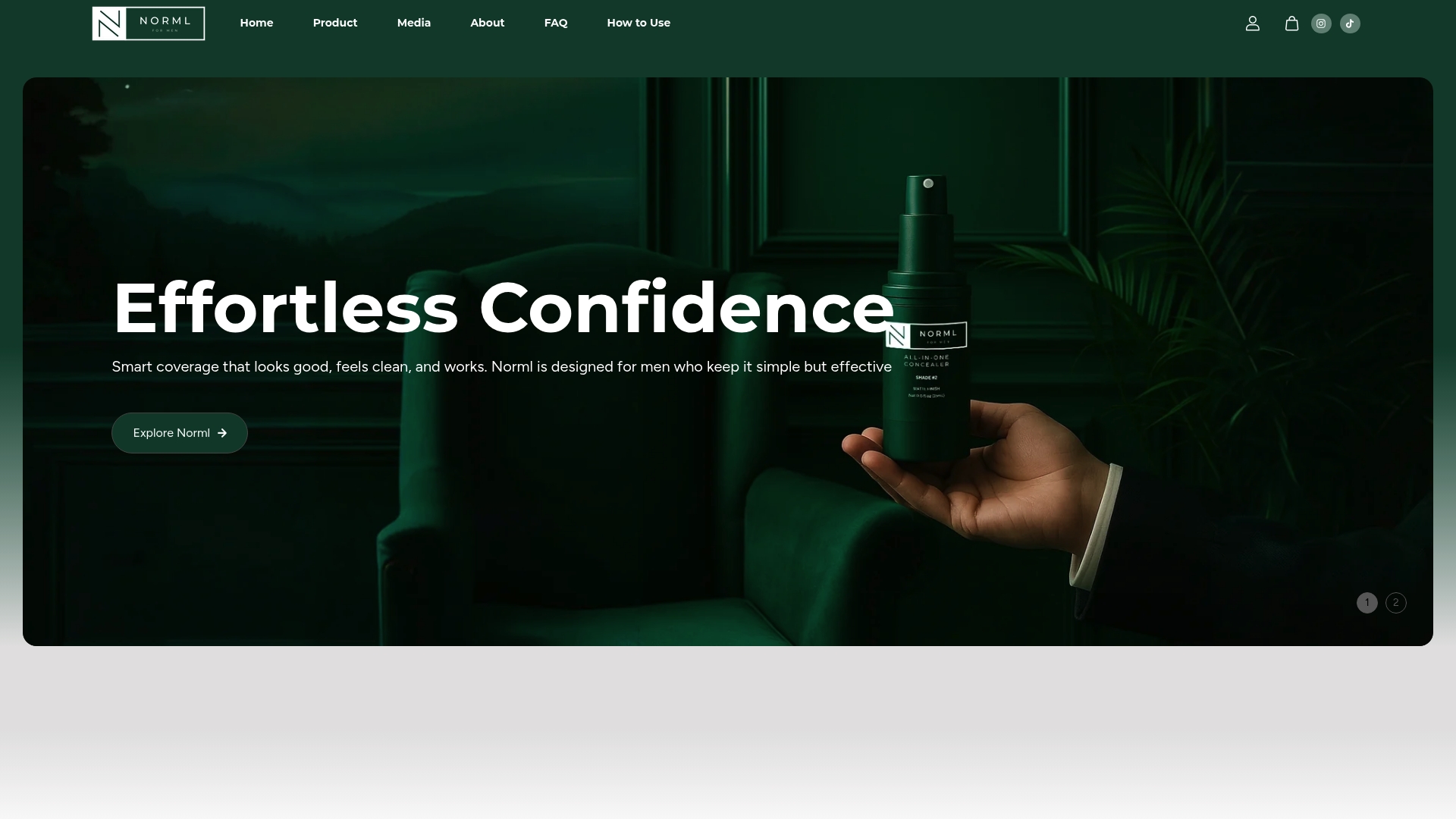
If grooming is part of your confidence strategy, the product you use matters. Norml4men’s all-in-one concealer is built specifically for men who want to cover blemishes, redness, and dark circles without looking like they are wearing anything. It is lightweight, matte, and formulated to blend into your skin tone so the result looks like your face on a good day. No cakey finish, no obvious coverage. Just a sharper, more even appearance in under a minute. If you want a fast, low-effort grooming upgrade that directly supports your skin confidence, this is the place to start.
FAQ
What is the fastest way to build confidence as a man?
The fastest method is exposure-based practice: enter a situation that triggers mild anxiety, stay in it, and rate the actual outcome afterward. A 2026 CBT trial showed significant confidence gains in just 12 hours using this approach.
Why do affirmations not work for building male confidence?
Affirmations do not generate the mastery experiences that drive real self-efficacy. Research confirms that proven task completion produces confidence gains, while self-talk without behavioral evidence does not.
How does self-compassion help men become more confident?
Self-compassion reduces the emotional cost of setbacks, keeping you willing to attempt confidence-building behaviors again. A targeted self-compassion intervention maintained stress reduction at three months, longer than standard mindfulness programs.
Can grooming genuinely improve a man’s confidence?
Yes. Appearance-related self-efficacy affects posture, eye contact, and social presence in measurable ways. Addressing visible skin concerns with products like Norml4men removes a source of distraction that can undermine performance in social and professional settings.
How do I track confidence improvements over time?
Rate specific confidence-related behaviors on a one-to-ten scale after each attempt and review weekly. This method mirrors behavior-linked self-efficacy measurement used in clinical research and makes progress visible rather than relying on vague feelings.


