

How to hide redness on your face: real solutions that work
TL;DR:
- Managing facial redness involves identifying triggers and adopting a simple skincare routine to reduce irritation and improve coverage.
- Using a gentle cleanser, barrier-supporting moisturizer, and a skin-tone concealer allows men to conceal redness naturally without heavy products or detection.
- Consistency and proper application techniques are key to achieving a confident, undetectable finish in everyday situations.
Facial redness doesn’t just affect your skin. It affects how you walk into a room, how you feel during a job interview, and how confident you look when it matters most. The problem is that most fixes are either too obvious or too complicated. Nobody wants to show up to a meeting looking like they applied stage makeup in the parking lot. This article breaks down a practical, step-by-step approach to managing and concealing facial redness in a way that’s genuinely undetectable, using real techniques and products built for men who want results without the attention.
Table of Contents
- Understanding facial redness in men
- Prepping your skin: what you need to start
- Step-by-step: How to conceal redness without detection
- Troubleshooting and avoiding common mistakes
- Verifying your results: How to check your work
- The truth about men’s redness solutions: why the simple approach works best
- Take the next step with Norml: solutions designed for men who want real results
- Frequently asked questions
Key Takeaways
| Point | Details |
|---|---|
| Know your triggers | Identifying and avoiding triggers can reduce redness and the need for heavy cover-up. |
| Gentle products work best | Use mild skincare with ingredients like niacinamide and oatmeal to soothe skin. |
| Less is more | Conceal with a light touch for natural-looking results that stay discreet all day. |
| Routine makes a difference | A simple daily routine can keep redness under control and build your confidence. |
Understanding facial redness in men
To understand how to effectively conceal redness, it’s helpful to know what’s causing it in the first place.
Facial redness in men comes from a wider range of sources than most people realize. Heat exposure, intense workouts, alcohol, stress, and even harsh skincare products can all trigger visible flushing. These are situational causes, meaning they flare up and then fade. But other causes like rosacea (a chronic skin condition that causes persistent redness and sometimes visible blood vessels), contact dermatitis from product irritation, seasonal allergies, and UV sun damage tend to stick around longer and require a more consistent management strategy.
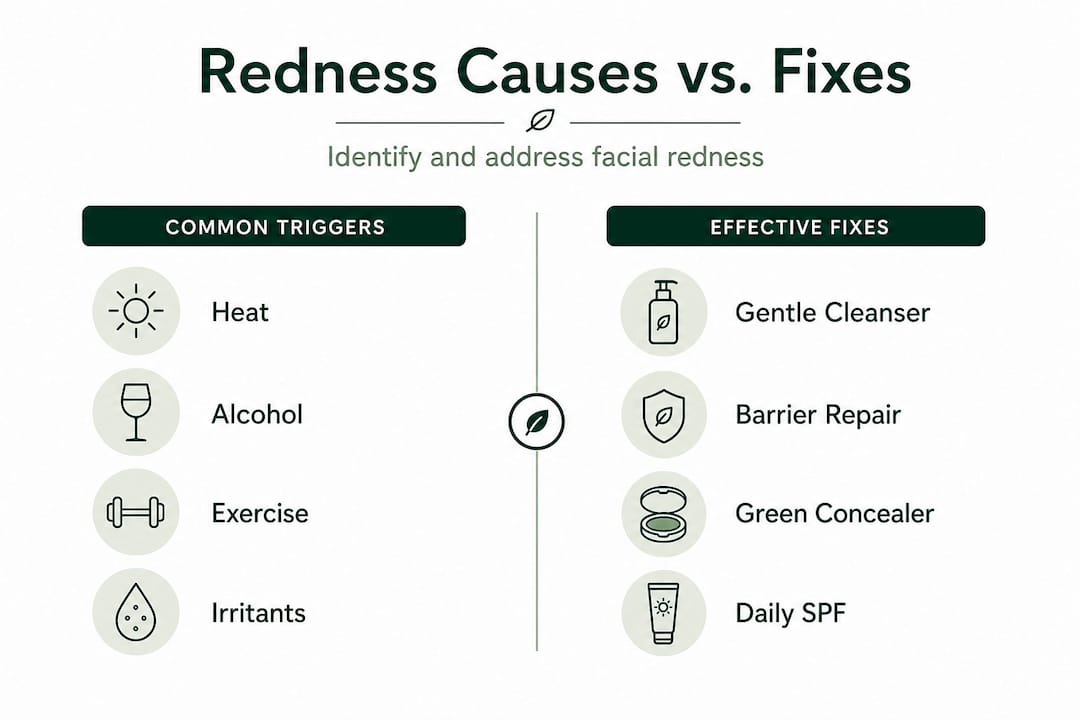
Understanding the difference between these categories matters because it changes your approach. If your redness is purely situational, you can often reduce it significantly by modifying habits. If it’s chronic, you’ll need both a solid skincare routine and occasional coverage. Either way, knowing your specific triggers gives you a real advantage.
Common redness triggers include:
- Heat and humidity, which dilate blood vessels near the skin’s surface
- Alcohol consumption, which causes temporary but intense flushing in many men
- High-intensity exercise, which increases core body temperature and blood flow to the face
- Stress and anxiety, which activate inflammatory responses that show up on your skin
- Harsh skincare products, especially those with alcohol, fragrance, or strong exfoliants
“Redness often has triggers; focusing on trigger avoidance plus gentle barrier-supporting ingredients can reduce the amount of cover-up needed over time.” via CNN Underscored on rosacea and redness
Many men dealing with redness also have an impaired skin barrier, meaning the protective outer layer of the skin isn’t functioning well. When that barrier breaks down, skin becomes more reactive and prone to visible irritation. Addressing common skin issues for men at the barrier level is one of the most effective long-term strategies available.
Prepping your skin: what you need to start
Once you know the cause and your goal, you’ll need the right products and tools for effective redness control and coverage.
Preparation is where most men skip steps and then wonder why their results look off. Applying concealer directly to dry, unprepared skin is like painting over a rough wall without priming it. The result is patchy, obvious, and doesn’t last. A good prep routine takes less than five minutes and makes the actual coverage step dramatically more effective.
Here’s what you need:
| Product | Purpose | What to look for |
|---|---|---|
| Gentle cleanser | Removes dirt and oil without stripping the skin | Fragrance-free, sulfate-free |
| Moisturizer | Hydrates and supports barrier function | Niacinamide, colloidal oatmeal, ceramides |
| Sunscreen | Prevents UV-triggered redness and flares | SPF 30+, mineral preferred for redness |
| Concealer | Covers visible redness discreetly | Skin-tone match, matte finish |
| Azelaic acid treatment (optional) | Reduces chronic redness over time | 10-15% concentration |
The ingredient list matters here. Niacinamide (a form of vitamin B3) reduces redness and strengthens the skin barrier. Colloidal oatmeal calms inflammation and is particularly effective for reactive skin. Azelaic acid targets the underlying redness from rosacea and post-inflammatory skin issues. These aren’t trendy buzzwords. They’re ingredients that actually work, and research consistently supports using “gentle products free of potentially irritating ingredients, prioritizing ingredients that calm inflammation, strengthen barrier, and support the microbiome.”
Getting a handle on the full picture is easier with a solid men’s skincare checklist that organizes exactly what to use and when. If you’re newer to this space, a good men’s cosmetics overview can help you understand what’s available without the confusion.
Pro Tip: Always apply sunscreen as the final step in your skincare routine and before any concealer. Sunscreen seals in your other products and creates a smoother base for coverage. Skipping it not only leaves your skin vulnerable to UV-triggered redness but also reduces how long your coverage lasts.
Step-by-step: How to conceal redness without detection
Now that you’re prepped, it’s time to cover redness with methods that are genuinely undetectable.
Technique matters as much as product choice. Even the best concealer looks bad if it’s applied wrong. Follow this sequence for the cleanest, most natural results:
- Cleanse your face with a gentle, fragrance-free cleanser. Pat dry, don’t rub. Rubbing creates friction that can actually trigger more redness before you’ve even started.
- Apply moisturizer while skin is still slightly damp. This locks in hydration and gives you a smoother surface. Let it absorb for 60 to 90 seconds.
- Apply sunscreen as the final skincare step. Ingredients like niacinamide and azelaic acid in your moisturizer do more when sunscreen protects them from UV degradation. Give it 60 seconds to set.
- Choose your concealer approach based on the severity of your redness.
- Apply concealer in thin layers using your ring finger or a small blending sponge. Start with the most affected areas and blend outward in small circular motions.
- Check your blend in natural light before leaving the house.
When it comes to concealer types, here’s a quick breakdown:
| Concealer type | Best for | Risk |
|---|---|---|
| Green-tinted corrector | Heavy, intense redness | Can look gray or ashy if not layered correctly |
| Skin-tone concealer (matte finish) | Everyday coverage | Must match your exact tone or it will be visible |
| Tinted moisturizer | Light, diffuse redness | Lower coverage but very natural looking |
| All-in-one men’s concealer | Daily use, discreet finish | Requires tone-matching at purchase |
Most men are better served by a skin-tone concealer with a matte finish rather than a green corrector. Green correctors require a second layer of product on top, which adds bulk and increases the chance of a cakey, obvious look. A well-matched skin-tone concealer, applied in a thin layer, tends to look more natural and requires less effort. Exploring natural makeup steps for men can help you build confidence with application techniques if this is new territory.
Pro Tip: Warm a small amount of concealer between your fingertip and thumb for a few seconds before applying. This softens the product and makes it blend more naturally into skin rather than sitting on top of it.
Troubleshooting and avoiding common mistakes
Even with the right products, a few mistakes can ruin an otherwise flawless result. Here’s how to fix or avoid them.
The most common mistake men make is applying too much product. More coverage does not equal better coverage. A thick layer of concealer catches in fine lines, settles into pores, and creates an uneven texture that actually draws more attention to your face than the redness would have.
Common mistakes and how to fix them:
- Cakey or heavy coverage: Apply less product and use a damp blending sponge to press and pat rather than swipe. If it’s already on your face, lightly pressing a clean sponge over the area can redistribute and thin it out.
- Streaks or lines: These usually happen when skin isn’t moisturized enough or when concealer is applied in long strokes. Always blend in small motions and make sure your moisturizer has fully absorbed first.
- Color mismatch: Concealer that’s too light will highlight redness by contrast. Too dark and it looks like a shadow. If you’re unsure, test on the side of your jaw in natural light before committing.
- Increased redness after application: Some products contain irritants that trigger a flare. Check your ingredient list for alcohol, strong fragrance, or menthol.
“Gentle barrier-supporting products free of potential irritants are best for reducing flare-ups and keeping skin calm.” via CNN Underscored
It’s also worth noting that rushing through your routine causes most blending errors. Giving yourself an extra two minutes makes a visible difference. A focused approach to effective skin care tips for men will help you build habits that prevent these problems from appearing in the first place.
Verifying your results: How to check your work
You’ve finished your routine. Here’s how to make sure it looks perfect wherever you go.
One of the most overlooked steps in any coverage routine is the final check. Most bathroom lighting is warm and flattering, which means it hides imperfections that other environments will expose. Natural daylight is the harshest and most revealing, and it’s what people see you in most of the time.
Here’s how to verify your results before stepping out:
- Step near a window and look at your face in natural daylight. This is the single most reliable check for undetectable coverage.
- Use your phone’s front-facing camera in photo mode, not selfie mode, since photo mode uses sharper processing. This mimics how others might photograph you and exposes blending edges or color mismatches.
- Check multiple angles: tilt your face slightly to the left and right. Blending errors often hide in straight-on views but show up at an angle.
- Look for texture differences between covered and uncovered areas. If the concealed area looks smoother or more matte than surrounding skin, blend outward slightly.
- Wait five to ten minutes after finishing before you check. Products settle and shift slightly as they dry, and what looked perfect at application may look different once fully set.
Research consistently highlights that daily sunscreen is a critical step in preventing future redness, meaning your verification routine today also protects your results tomorrow. Men who combine a consistent skincare foundation with targeted concealer report noticeably improved confidence in high-stakes social and professional situations. The effect isn’t just cosmetic. Clear, even skin changes how you carry yourself. Learning how to build natural confidence through skincare is a long game with real, measurable payoffs.
The truth about men’s redness solutions: why the simple approach works best
Looking back at the full process, there are a few hard truths worth saying plainly.
Most men who struggle with redness coverage aren’t using the wrong products. They’re using too many products. There’s a widespread belief that more steps equal better results. The reality is the opposite. Every additional product introduces another potential irritant, another layer of texture, another chance for something to pill, shift, or flare up.
We’ve seen men go through eight-step routines with correcting primers, green concealers, setting powders, and finishing sprays. The result? Heavy, obvious coverage that moved around by midday and drew exactly the kind of attention they were trying to avoid. When those same men switched to a well-matched moisturizer, sunscreen, and a single quality concealer, they got better results in less time. It sounds too simple. That’s exactly why it works.
The men who get the best results from a redness concealing routine are the ones who commit to consistency over complexity. A gentle cleanser every morning, a calming moisturizer, daily SPF, and a concealer that actually matches their skin tone used every day for three weeks will outperform any complicated multi-product system used inconsistently.
There’s also a psychological element worth addressing. Many men hesitate to use concealer because they associate it with high-maintenance behavior or worry that someone will notice. But the goal isn’t to transform your face. It’s to even it out slightly so that redness doesn’t dominate your appearance or undermine your confidence. When done right, no one notices you’re wearing anything. They just notice you look good. That’s exactly the point of understanding why skincare matters for men at a deeper level than just surface appearance.
Take the next step with Norml: solutions designed for men who want real results
If you want to put these strategies into action, there are easy ways to get started with discreet, powerful solutions made for men.
Norml was built specifically for situations like this. It’s a lightweight, matte all-in-one concealer that covers redness, blemishes, and dark circles without looking like you’re wearing anything at all. No heavy texture. No obvious finish. No complicated routine.

The Norml All-In-One Concealer is designed to blend seamlessly into your skin tone so you look sharper and more even in seconds. Whether you’re heading into a job interview, a first date, or a long workday, it gives you the coverage you want without the attention you don’t. Visit the NORML homepage to find your shade and start building the kind of simple, effective routine this article describes. It really is this straightforward.
Frequently asked questions
What ingredients should I look for to reduce facial redness?
Gentle ingredients like niacinamide, colloidal oatmeal, and azelaic acid are your best starting points because they calm inflammation and strengthen the skin barrier without causing additional irritation.
How do I cover redness so it doesn’t look obvious?
Start with a hydrating moisturizer, then apply a thin layer of skin-tone matched concealer using your fingertip and blend outward. Trigger avoidance and barrier-supporting skincare reduce how much coverage you need over time.
Does sunscreen matter if I’m only concerned about redness?
Absolutely. UV exposure is one of the most common redness triggers, and daily sunscreen is a critical step for preventing flares and protecting the effectiveness of your other skincare products.
How can I prevent my skin from looking cakey or unnatural?
Always moisturize before applying concealer and use a minimal amount of product. Gentle, barrier-supporting products also create a smoother base so coverage sits naturally rather than clumping or settling into texture.
Are there any quick fixes for redness if I’m in a rush?
A tinted moisturizer with calming ingredients like niacinamide can even your skin tone in under a minute and works well on its own when redness is mild or when you need something fast before walking out the door.


