

Skin Tone Correction: Boosting Confidence Instantly
Finding the right approach for evening out your complexion can feel like a daily challenge, especially when urban life and professional demands highlight every imperfection. When you face redness, dark circles, or sun spots, these concerns stand out and shape your confidence in both the office and social gatherings. Skin tone correction empowers you to present a consistent, natural look quickly, helping you show up as your best self without worrying about uneven skin.
Table of Contents
- What Is Skin Tone Correction?
- Types of Corrections and Color Concerns
- How Effective Products Deliver Natural Results
- Common Application Mistakes to Avoid
- Choosing the Right Solution for Men
Key Takeaways
| Point | Details |
|---|---|
| Understanding Skin Tone Correction | It balances uneven coloration and imperfections for a natural look without the heavy makeup effect. |
| Importance of Undertones | Knowing your skin’s undertone is crucial for selecting the right correction products that blend seamlessly. |
| Application Techniques Matter | Proper product application and blending techniques prevent visible makeup and enhance natural skin texture. |
| Customizing Solutions for Men | Men should choose products tailored to their unique skin physiology and specific concerns for effective outcomes. |
What Is Skin Tone Correction?
Skin tone correction is the process of addressing uneven coloration, discoloration, and imperfections across your face to achieve a balanced, natural appearance. Think of it like color grading in photography—it’s about bringing harmony and consistency to what’s already there, not creating something fake.
Your skin naturally displays variations. Redness around the nose, darker patches under eyes, uneven pigmentation from sun exposure, or inflammatory spots interrupt the uniform tone you’re aiming for. Skin tone correction addresses common challenges like these by evening out color and lighting inconsistencies across your face.
This goes beyond skincare routines or long-term treatments. Skin tone correction delivers instant results—something you can use in minutes before a presentation, video call, or night out.
How It Works in Real Life
The concept is straightforward. Your goal is to neutralize problem areas while maintaining your natural skin tone and texture. This involves:
- Covering unwanted redness (common on cheeks, chin, or around the nose)
- Minimizing the appearance of dark circles and under-eye shadows
- Balancing hyperpigmented spots or uneven patches
- Creating a consistent complexion without the “makeup” look
Unlike heavy coverage products designed for theatrical use, modern skin tone correction tools work with your skin, not against it. They blend seamlessly and remain invisible during daily activities.
Why It Matters for Your Confidence
You notice these imperfections more than anyone else does. But that awareness affects how you present yourself. When your complexion feels uneven, you’re more likely to adjust your framing on video calls, avoid bright lighting, or second-guess your appearance in mirrors.
Correct your skin tone, and you eliminate that mental friction. You show up as your best self without the distraction of thinking about what others might notice.
Skin tone correction is about control—deciding what your face looks like, not letting imperfections make that decision for you.
The Core Difference From Makeup
Traditional makeup emphasizes and enhances features. Skin tone correction minimizes disruption. It’s subtle enough that people won’t ask what you’re wearing, yet effective enough to transform your appearance in seconds.
Your skin tone is unique to you. The goal isn’t to change who you are—it’s to present the clearest, most consistent version of yourself.
Pro tip: Start with small applications on problem areas like dark circles or redness, then build coverage gradually—this prevents the “over-applied” look while giving you maximum flexibility throughout your day.
Types of Corrections and Color Concerns
Not all skin tone problems look the same. Your face might deal with multiple color issues simultaneously—dark circles under the eyes, redness on the cheeks, brown spots from sun damage, and uneven patches across your jawline. Understanding what you’re correcting helps you address each concern effectively.
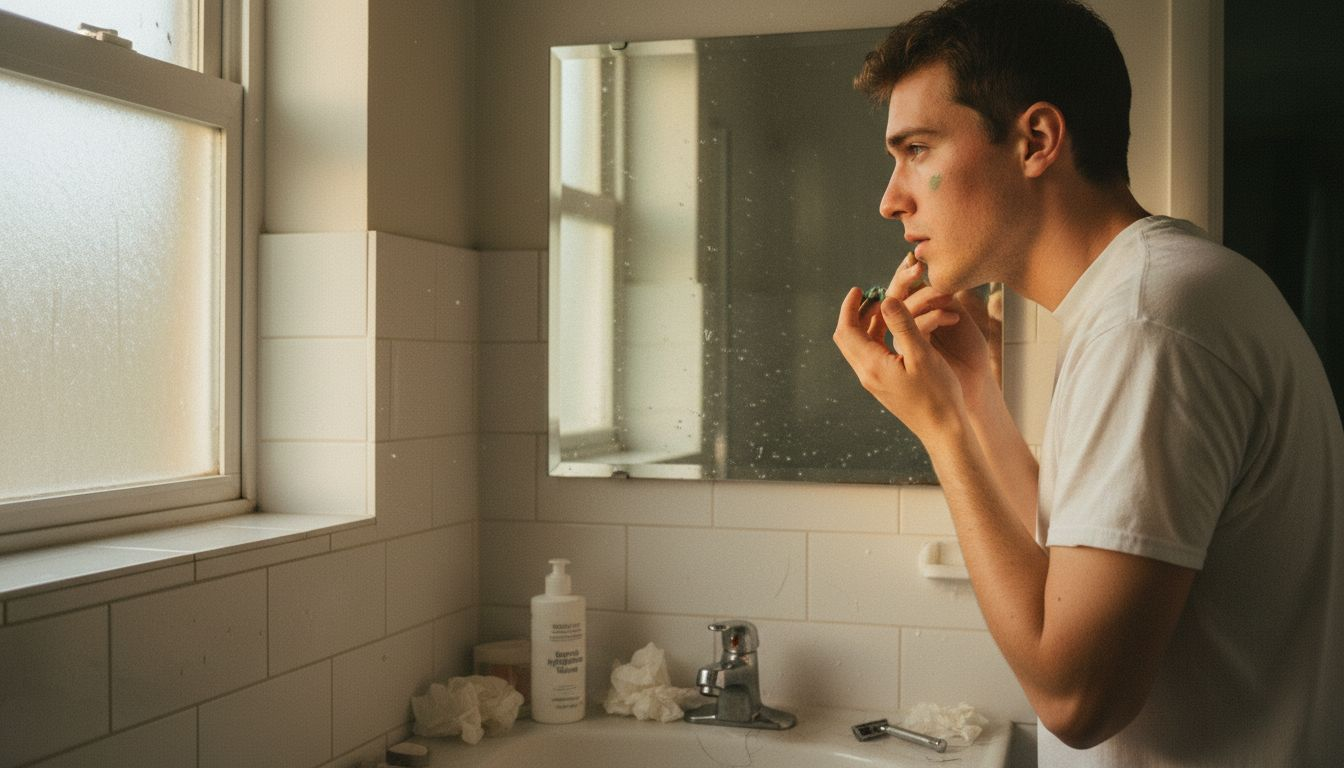
Skin tone issues fall into two main categories: hyperpigmentation (darker patches) and hypopigmentation (lighter patches). Most men deal with hyperpigmentation issues like post-inflammatory marks, sun damage, or age spots. Pigmentation irregularities vary based on ethnicity and UV exposure00215-9/fulltext), which is why your specific concerns might differ from your friends’.
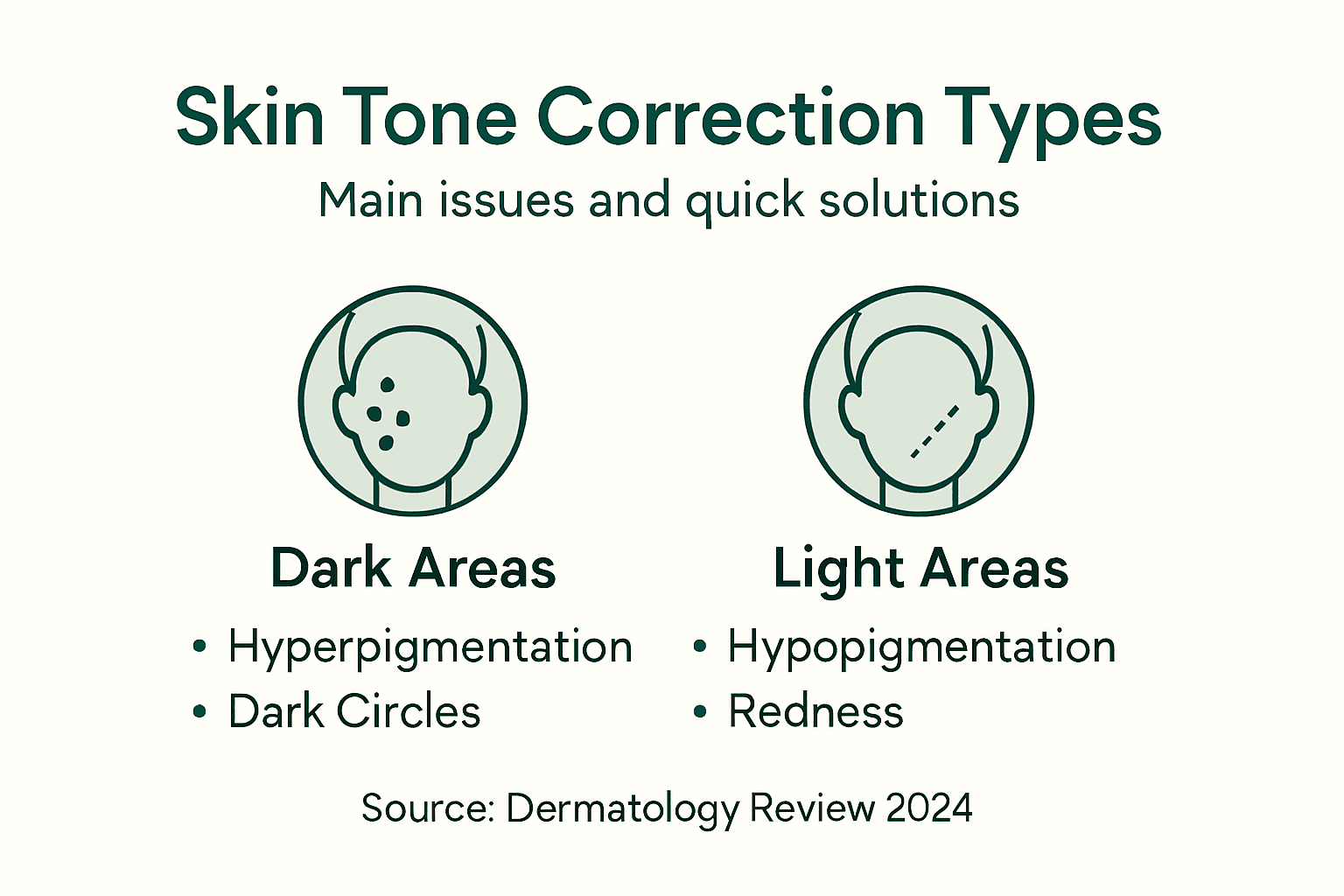
Common Color Concerns You’ll Face
Here are the color issues that interrupt your complexion most frequently:
- Dark circles and under-eye shadows — Often genetic, worsened by fatigue, or caused by natural skin translucency under thin eye skin
- Redness and inflammation — From acne, rosacea, or irritation on cheeks, chin, or around the nose
- Hyperpigmented spots — Sun damage, age spots, or post-acne marks that appear darker than surrounding skin
- Uneven patches — Areas where skin tone shifts noticeably between different parts of your face
- Sallow or dull appearance — Lack of luminosity making skin appear flat or tired
Each concern requires a slightly different approach to correction. Dark circles demand color neutralization combined with light reflection. Redness needs direct color cancellation. Sun spots require careful blending to match surrounding tone.
Here’s a comparison of common skin tone issues and their ideal correction methods:
| Skin Tone Issue | Typical Cause | Best Correction Approach | Result |
|---|---|---|---|
| Dark circles | Genetics, fatigue | Color neutralization with light-reflecting pigment | Brighter, refreshed under-eye |
| Redness | Acne, irritation | Direct color cancellation with matched concealer | Reduced visible redness |
| Hyperpigmentation | Sun exposure, aging | Precise shade matching and blending | Even, natural skin tone |
| Uneven patches | Inflammation, genetics | Layered correction and blending | Uniform complexion |
| Sallow/dullness | Tiredness, lack of circulation | Illuminating correction and subtle highlight | Healthier, radiant skin appearance |
Why Your Skin Type Matters
Your baseline skin tone affects how color problems appear and how correction should work. Skin classification systems help tailor corrective approaches by understanding your specific skin phototype and how you respond to different treatments.
Fairer skin shows redness and discoloration more obviously. Deeper skin tones display hyperpigmentation differently. Medium tones present their own set of challenges. The correction strategy that works perfectly for one man might need adjustment for another.
The best correction matches your natural undertone while neutralizing the problem—not fighting against what you’re starting with.
Addressing Multiple Concerns at Once
Your face rarely has just one problem. You might have dark circles, some redness, and a few spots. The solution is layering corrections strategically—starting with the deepest issues and building toward surface problems.
Start with color correction for the most problematic concern. Then address secondary issues. This prevents over-applying and maintains a natural look.
Pro tip: Identify your main color concern first (usually dark circles or redness), then address secondary issues—this prevents product buildup and keeps your look seamless and undetectable.
How Effective Products Deliver Natural Results
The difference between a product that looks obvious and one that disappears on your skin comes down to formulation. Not all skin tone correction products work equally. The best ones use advanced delivery systems and carefully selected ingredients to blend seamlessly while actually addressing the underlying color problem.
Effective products work in multiple layers. They neutralize color through strategic pigment choices, provide coverage that matches your skin’s light-reflecting properties, and maintain a texture that feels like skin—not paint. This requires precision in both ingredient selection and how those ingredients are delivered to your skin.
The Science Behind Invisible Coverage
When a product sits on your skin, light interacts with it differently than it interacts with actual skin. Cheap products create a visible “mask” because the particles are too large or the finish doesn’t mimic skin’s natural light reflection. Quality formulations solve this through micro-distribution—breaking down pigments and coverage agents into particles so small they integrate with your skin rather than sitting on top of it.
Natural product formulations enhance delivery through advanced technologies like liposomes and nanoparticles, ensuring ingredients reach where they’re needed and absorb properly.
What Makes a Formula Work
Look for these qualities when evaluating a skin tone correction product:
- Precise color matching — Formulated in multiple shades to match different skin tones, not just “light,” “medium,” “dark”
- Lightweight texture — Sits on skin without feeling heavy, flaking, or transferring to clothing
- Matte finish — Avoids shine that draws attention; blends into your natural skin tone
- Long wear — Stays in place through meetings, workouts, or full days without reapplication
- Blendability — Merges seamlessly with surrounding skin; no harsh edges or visible lines
Products that deliver on these fronts typically use specialized formulation techniques to control particle size, optimize pigment suspension, and create the right balance of slip and adhesion.
To help you choose an effective skin tone correction product, here is a summary of key formulation qualities:
| Product Quality | Why It Matters | Impact on Appearance |
|---|---|---|
| Precise color match | Avoids mismatched tones | Seamless, natural finish |
| Lightweight texture | Prevents heaviness | Comfortable wear all day |
| Matte finish | No unwanted shine | Undetectable correction |
| Long wear | Lasts through activity | Consistent coverage |
| High blendability | Smooth transitions | Invisible edges |
Why Ingredient Quality Matters
Not all coverage comes from the same place. Some formulations rely on heavy mineral pigments that look chalky. Others use synthetic colorants that don’t match skin undertones well. The best products combine color-correcting ingredients with skin-tone-matching pigments, creating actual correction rather than just concealment.
A natural-looking result isn’t about hiding—it’s about correction that matches your skin so perfectly that nothing looks corrected at all.
Blending Technology as Your Advantage
Advanced products incorporate optical blending—using the right combination of matte and subtle luminous particles to create depth without shine. This makes the product disappear into your skin instead of appearing as a layer on top of it.
Your skin has texture, natural variation, and dimension. Effective products respect that rather than creating a flat, artificial appearance.
Pro tip: Apply with minimal product—start with a pea-sized amount and build coverage in thin layers, which actually creates a more natural result than applying one thick coat.
Common Application Mistakes to Avoid
Most men ruin their skin tone correction not because they’re using the wrong product, but because they’re applying it wrong. A quality formula can’t save you from technique errors. Understanding what goes wrong helps you achieve the invisible result you’re after.
The mistakes fall into predictable patterns. You apply too much product. You blend incorrectly. You ignore your skin’s undertone. You rush the process. Each of these errors transforms a natural correction into something that looks obviously like makeup.
The Overcorrection Trap
More product doesn’t equal better results. It equals visible coverage. When you apply too much, the product sits on your skin instead of integrating with it. You create a mask effect—exactly what you’re trying to avoid.
Overcorrection results in unnatural hues and uneven patches that stand out under various lighting. Start with less. You can always add more. You can’t easily remove what’s already there.
Begin with a pea-sized amount. This seems insufficient until you actually blend it. Most men are surprised how far quality product stretches when applied correctly.
Ignoring Your Undertone
Your skin has a natural undertone—warm, cool, or neutral. A correction that matches your undertone disappears. One that fights it looks obviously applied. Many men choose shades that are too light, too dark, or the wrong temperature entirely.
Hold the product next to your jaw in natural light. If it matches perfectly, it’s your shade. If it looks noticeably different, it’s wrong for you.
Undertone matters more than you think. A “medium” shade that’s warm-toned will clash if your skin is cool-toned, no matter how well you apply it.
Blending and Layering Errors
Proper blending requires time and the right technique. Here’s what goes wrong:
- Patchy blending — Leaving obvious edges or unblended sections
- Over-blending — Rubbing the product so much it breaks apart or becomes transparent
- Blending in wrong direction — Moving against skin texture instead of with it
- Skipping transition zones — Not feathering where correction meets uncorrected skin
- Wrong tools — Using fingers when a damp sponge works better, or vice versa
Each technique error creates a different visible problem. Some look cakey. Others look streaky. The solution is understanding your specific blending style.
The Lighting Problem
You apply your correction indoors under artificial light. Then you walk outside into natural sunlight and look completely different. Neglecting to preserve original lighting conditions impacts realism and how your correction appears throughout your day.
Always check your application in multiple lighting conditions—natural light, office light, and the lighting where you’ll spend most of your time.
The best correction looks identical in every lighting environment. If it looks good in one and bad in another, your undertone matching or application technique needs adjustment.
Texture Destruction
When you blend too aggressively or use too much product, you smooth away your skin’s natural texture. This creates an unnatural, plastic appearance—the opposite of what you want.
Your skin has pores, slight variation, and dimension. Effective correction preserves this. It should enhance, not erase.
Pro tip: Apply in thin layers using a damp beauty sponge with stippling motions (pressing rather than rubbing), which preserves texture while creating seamless blending.
Choosing the Right Solution for Men
Your skin isn’t the same as anyone else’s. Neither are your lifestyle demands, skin concerns, or aesthetic preferences. A one-size-fits-all approach to skin tone correction fails because it ignores what actually matters—your specific situation.
Choosing the right solution means understanding your skin type, identifying your primary concern, and selecting a product that fits your daily routine. Men have distinct advantages here. Your skin is typically thicker and oilier than women’s, which changes how products perform and what you need.
Understanding Your Specific Skin Profile
Men’s skin physiology differs in thickness, oiliness, and hormonal influences compared to other demographics. This matters for product selection. A lightweight formula might work perfectly for you while feeling insufficient for someone with drier skin.
Start by identifying your primary concern:
- Dark circles (requires color neutralization and light reflection)
- Redness or inflammation (needs direct color correction)
- Hyperpigmented spots (demands precise shade matching)
- Uneven overall tone (benefits from full-face coverage)
- Post-acne marks (requires buildable coverage)
Your main concern should drive your product choice. Everything else is secondary.
Assessing Your Skin Tone and Undertone
You need to know your undertone before buying anything. Warm, cool, or neutral undertones respond differently to corrective shades. A warm-toned product on cool-toned skin looks obviously applied—no matter how well you blend it.
Test products on your jaw in natural sunlight. If it matches seamlessly, it’s the right shade. If it looks noticeably different—lighter, darker, or slightly off in color—keep looking.
Practical Lifestyle Factors
The best product is useless if it doesn’t fit your actual life. Consider these realities:
- Application time — Do you have 30 seconds or 5 minutes in the morning?
- Duration needed — Will you wear it through a full workday or just for specific events?
- Activity level — Do you exercise, travel, or work in variable lighting environments?
- Skin sensitivity — Does your skin react to ingredients, or are you more tolerant?
- Portability — Do you need to touch up throughout the day?
A product that requires careful blending and perfect lighting conditions won’t work if you’re rushing to meetings. Similarly, a simple stick formula won’t deliver the coverage you need for serious hyperpigmentation.
Professional vs. At-Home Solutions
Customized approaches tailored for men address concerns like post-acne marks and sun damage through combinations of professional procedures, daily routines, and lifestyle practices.
Some situations benefit from professional dermatological treatment. Severe melasma, extensive sun damage, or significant post-acne scarring might require in-office procedures. For everyday color issues and confidence, an effective at-home product is typically the practical choice.
The right solution matches your skin tone, addresses your specific concern, and fits your actual daily routine—not the routine you wish you had.
Testing Before Committing
Don’t buy full-size products without testing first if possible. Sample sizes exist for this reason. A product that works perfectly in the store under ideal lighting might disappoint at your office desk under fluorescent lights.
Test for at least three days in your normal environment before deciding. This reveals how the product performs when you’re moving, talking, and living your life—not standing still in a mirror.
Pro tip: Match your undertone by holding product against your jawline in natural sunlight, testing in the lighting where you’ll spend most time, then choosing based on how it looks in both environments combined.
Achieve Natural Skin Tone Correction with Norml
The article highlights common challenges like redness, dark circles, and uneven patches that disrupt your natural skin tone and confidence. If you struggle with these issues and want to avoid heavy coverage or an artificial look, focus on products designed specifically for men that offer precise color neutralization and seamless blending. Norml addresses these exact pain points with a lightweight, matte formula crafted to correct discoloration instantly while preserving your natural skin texture and undertones.

Ready to stop worrying about visible skin imperfections and step into every room feeling sharp and in control Take the first step today by exploring how Norml’s all-in-one concealer can transform your appearance without anyone noticing. Visit Norml for Men now to discover your perfect shade and enjoy effortless skin tone correction designed just for you. See how a subtle solution creates undeniable confidence that lasts all day.
Frequently Asked Questions
What is skin tone correction?
Skin tone correction is the process of addressing uneven coloration, discoloration, and imperfections on the face to achieve a balanced, natural appearance. It helps neutralize problem areas while maintaining the skin’s natural texture.
How does skin tone correction boost confidence?
Correcting skin tone helps minimize the awareness of imperfections, allowing individuals to present their best selves without distraction. It eliminates mental friction and enhances overall confidence in appearance.
What are common skin tone issues that need correction?
Common issues include dark circles, redness, hyperpigmented spots, uneven patches, and a sallow appearance. Each concern requires a specific correction approach to achieve an even complexion.
How should I apply skin tone correction products for the best results?
Start with small applications on the most problematic areas and blend gradually to avoid an over-applied look. Use tapping motions with a damp sponge for better integration and a natural finish.
Recommended
- Norml – Men’s All-in-One Concealer & Skincare Hybrid – NORML
- Norml All-In-One Concealer – NORML
- How to Use – NORML
- Home page – NORML
- Why Target Uneven Skin Tone for Radiant Aging – Cellure
- Brightening Skin Care Ingredients ৹ Top 6 Proven to Help
- Reveal Radiant, Even-Toned Skin with Skinbetter Science Even Tone Seru


