

How Confidence Shapes Your Appearance and Attractiveness
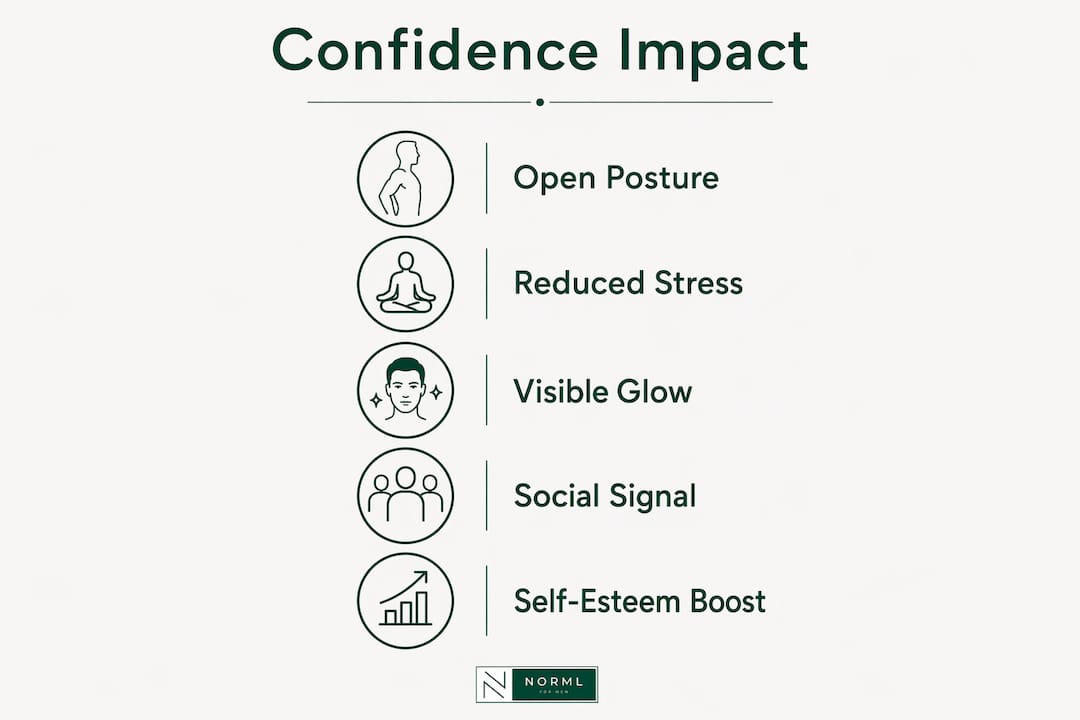
Confidence directly transforms how you look to others, not by changing your features, but by changing how those features are carried. Open posture, relaxed facial muscles, and steady eye contact signal ease to the brain, and the brain translates ease as attractiveness. A study of 2,748 participants rating 462 individuals confirmed that people perceived as more attractive are consistently rated as more intelligent, trustworthy, and sociable. Confidence underpins those perceptions before anyone consciously registers a single feature.
The core mechanisms at work:
- Posture: Upright, open posture adds perceived height and changes how clothes sit on the body
- Facial expression: Relaxed muscles produce genuine smiles and softer eye contact, both read as warmth
- Body language: Fluid, unhurried movement signals social ease and competence
- Stress reduction: Lower stress means less skin tension, fewer furrowed brows, and a clearer complexion
- Halo effect: One confident quality causes observers to assign other positive traits automatically
The distinction between practiced and authentic confidence matters here. Practiced confidence, adopting open posture when you feel nervous, produces real visual results. Authentic confidence, built over time through self-acceptance, sustains those results without effort. Both are worth pursuing, and neither requires perfect features to work.
How your self-image connects to emotional well-being
Self-image sits at the center of emotional health. How you perceive your own appearance shapes your mood, your stress levels, and your resilience in social situations. Research published in the Journal of Drugs in Dermatology found that a large proportion of self-esteem is tied to how a person perceives their own appearance, which makes the confidence-appearance relationship one of the most consequential in everyday psychology.
The facial feedback hypothesis adds another layer. When facial muscles move into expressions associated with positive emotion, mood follows. Studies show that volunteers who were prompted to smile rated stimuli as more pleasant, while those prompted to frown rated them more negatively. The implication: how you hold your face influences how you feel, not just how you look.
Factors that shape self-image and emotional resilience:
- Social feedback: Positive responses from others reinforce a favorable self-image
- Internal dialogue: Consistent self-critical thinking erodes confidence faster than any external pressure
- Physical health: Sleep, exercise, and nutrition all affect how you perceive your own face and body
- Grooming habits: Daily grooming routines create a sense of control and readiness that feeds directly into self-image
- Mindfulness: Awareness of negative thought patterns allows you to interrupt them before they compound
Confidence also lowers cortisol. Stress reduces skin quality by promoting inflammation and disrupting collagen production, so the emotional regulation that confidence provides has a literal, visible effect on the face.
How physical appearance affects self-esteem development
Appearance and self-esteem develop together, each shaping the other across a lifetime. The perception of one’s own physical attractiveness influences self-worth from early adolescence onward, and cultural standards set the benchmark against which most people measure themselves. Those standards shift by era, region, and media environment, which means self-esteem tied too tightly to appearance becomes unstable by design.
Research on men specifically shows that body comfort and self-esteem act as protective factors against societal appearance pressures. Men who feel comfortable in their bodies are less likely to pressure themselves to lose weight or pursue cosmetic procedures. Confidence, in that context, functions as a buffer rather than a response to meeting some external standard.
Key factors that influence how appearance shapes self-esteem:
- Cultural beauty standards: Narrow ideals create chronic dissatisfaction when appearance falls outside them
- Gender-specific pressures: Men face growing pressure around muscularity and skin clarity, often without the social permission to address it openly
- Peer comparison: Adolescent and young adult environments amplify appearance-based judgments
- Media exposure: Filtered images on social platforms distort baseline expectations for normal skin and body type
- Personal history: Compliments and criticism received during formative years leave lasting imprints on self-perception
The practical takeaway is that self-esteem built on appearance alone is fragile. Confidence grounded in competence, relationships, and self-acceptance holds up when appearance fluctuates, as it inevitably does.
Social benefits of projecting confidence through your appearance
Confident appearance produces measurable social advantages. In professional settings, people perceived as confident are more likely to be seen as competent and promotable. In personal contexts, confidence is perceived as romantically desirable, with research showing that men who projected social confidence in initial opposite-sex encounters were rated as significantly more romantically desirable than equally interested men who lacked that projection.

Body language carries most of that signal. Open posture, relaxed shoulders, steady gaze, and unhurried movement communicate ease before a word is spoken. The brain processes these cues automatically, assigning traits like trustworthiness and competence within milliseconds. Closing your posture or breaking eye contact reverses those impressions just as fast.
Social anxiety often shrinks this picture. When anxiety drives closed posture and avoidant eye contact, the social feedback loop runs in reverse: fewer positive responses, less reinforcement, lower confidence. The entry point for breaking that cycle is usually external, a grooming upgrade, a posture adjustment, a men’s appearance improvement that generates one positive social response and starts the loop moving in the right direction.
Media and social comparison complicate this further. Filtered images on Instagram and TikTok set appearance benchmarks that no unedited person meets, which means people who anchor their confidence to social media comparisons are working against themselves structurally. Redirecting that comparison inward, measuring against your own baseline rather than someone else’s highlight reel, is one of the most effective confidence shifts available.
What research says about how confidence changes how you look
The neuroscience here is specific. The brain processes confidence signals within 39 milliseconds, activating the amygdala, striatum, and prefrontal cortex to evaluate social cues for competence, trust, and approachability. That evaluation happens before conscious thought. By the time someone forms an opinion about whether they find you attractive, their brain has already processed your posture and facial expression dozens of times.
“Confidence shapes how beauty is perceived by influencing elements such as posture, facial expressions, and social engagement, all of which enhance attractiveness. When an individual exudes confidence and warmth, their attractiveness increases, even in the absence of conventional beauty standards.” — Journal of Drugs in Dermatology
The compensatory signal research adds a counterintuitive finding: displayed confidence compensates for lower conventional attractiveness by increasing perceived desirability. In other words, confidence does not just enhance existing attractiveness. For people who fall outside conventional beauty standards, it can functionally replace it as a social signal.
Physiologically, confidence triggers open posture, which improves blood oxygenation and produces a visible glow. Improved posture also changes the silhouette, adds perceived height, and alters how clothing drapes on the body. Facial muscle relaxation, the kind that comes with genuine ease rather than forced smiling, produces what researchers call the Duchenne smile: engagement of the muscles around the eyes that reads as authentic warmth and youth. Fillers and skincare cannot replicate that expression.
A boost in self-perceived attractiveness also reduces preference uncertainty in decision-making, meaning confident people make clearer choices and project that clarity outward. That decisiveness reads as competence, which feeds back into perceived attractiveness.
Practical ways to build confidence that shows up in your appearance
The most direct path to visible confidence runs through the body. Posture is the fastest lever: pull your shoulders back, lengthen your spine, and keep your chin level. That single adjustment changes your silhouette, your breathing, and how others read you. Practice it when you sit, not just when you walk into a room.
Grooming matters more than most men acknowledge. A consistent routine, clean skin, a sharp haircut, clothes that fit rather than just cover, creates a baseline of readiness that translates into ease. When you know you look put-together, you stop monitoring yourself and start engaging. That shift is visible. A fragrance that suits your personality adds another layer of self-assurance, one that operates below conscious awareness but registers in how you carry yourself.
Pro Tip: If uneven skin tone or visible blemishes pull your attention away from the room and back to your reflection, a lightweight matte concealer built for men handles that in seconds. Norml4men’s all-in-one concealer covers redness and dark circles without looking like anything is there, so you stop thinking about your skin and start focusing on the conversation.
Strategies that build authentic, lasting confidence:
- Fix your posture first: Shoulders back, chest open, spine tall. Do it now, not when you feel confident
- Groom consistently: A daily grooming routine removes the mental friction of wondering whether you look ready
- Dress for fit, not fashion: Clothes that fit your actual body project more confidence than expensive clothes that don’t
- Limit social media comparison: Measure your appearance against your own baseline, not filtered images
- Practice eye contact: Hold it a beat longer than feels comfortable. It reads as confidence immediately
- Use internal language deliberately: Replace “I look tired” with “I need more sleep.” One is a judgment; the other is a plan
- Seek social exposure: Confidence in social settings grows through repetition, not preparation
Internal self-acceptance and external presentation work together, not in competition. Addressing a visible concern, covering a blemish, wearing a better-fitting shirt, is not vanity. It removes a distraction so your attention can go where it belongs.
Key Takeaways
Confidence transforms appearance not by changing your features, but by changing how those features are carried through posture, expression, and ease.
| Point | Details |
|---|---|
| Confidence signals process fast | The brain evaluates confident body language within 39 milliseconds, assigning competence and attractiveness automatically. |
| Self-esteem and appearance are deeply linked | Research shows a large proportion of self-esteem ties to appearance perception, making confidence a direct lever on emotional well-being. |
| Confidence compensates for conventional attractiveness | Studies show displayed confidence increases perceived desirability even for those outside conventional beauty standards. |
| Posture and expression are the fastest levers | Open posture, relaxed facial muscles, and genuine smiles visibly enhance attractiveness without changing any physical feature. |
| Grooming creates a confidence feedback loop | Consistent grooming habits build readiness and ease, which generate positive social responses that reinforce confidence further. |
Norml4men: confidence starts with how you see yourself
Norml4men was built on one idea: when you stop worrying about how you look, you start showing up the way you actually want to. The Norml all-in-one concealer covers blemishes, redness, and dark circles with a lightweight matte finish that blends into skin so naturally that nobody knows it’s there. No cakey texture, no obvious coverage, no second-guessing. Just a cleaner, more even complexion in seconds, so your attention stays on the room, not the mirror.


