

Concealer for Work: A Quick, Natural Look for Men
A lightweight, skin-tone-matching concealer applied with your fingertips covers blemishes, redness, and dark circles in under a minute — and nobody at the office will know you’re wearing anything. That’s the whole premise, and it works. The role of makeup in professional settings, for men, comes down to one product used correctly: a creamy, matte concealer that makes your skin look like your skin, just better.
The 60-second micro routine: moisturize, let it absorb for 20 seconds, dot a tiny amount of concealer on problem areas, tap to blend with one finger, and you’re done. That’s it. The sections below break down every step so the finish stays invisible all day.
Key Takeaways
A skin-tone-matched concealer applied by fingertip in under 60 seconds is the most effective way for men to look polished and professional without visible product.
| Point | Details |
|---|---|
| Match your skin tone | Choose a shade that matches your face, not lighter — a lighter shade creates a visible pale patch. |
| Less product, always | One small dot per area is enough; build a second layer only if needed after the first blends in. |
| Tap, never rub | Tapping presses concealer into skin; rubbing streaks it and removes coverage. |
| Set for long days | A light press of translucent powder locks coverage through a full workday without adding visible product. |
| Norml4men All-In-One | Three flexible shades, matte finish, fingertip application — built for exactly this routine. |
Table of Contents
- How to build a 60-second concealer routine for work
- Where to apply concealer in professional settings
- How to pick the right concealer formula and shade
- Application techniques that keep concealer invisible
- Common mistakes that make concealer obvious
- Why grooming at work actually changes how people see you
- A note from Ford
- Norml4men All-In-One Concealer fits this routine exactly
- Sources
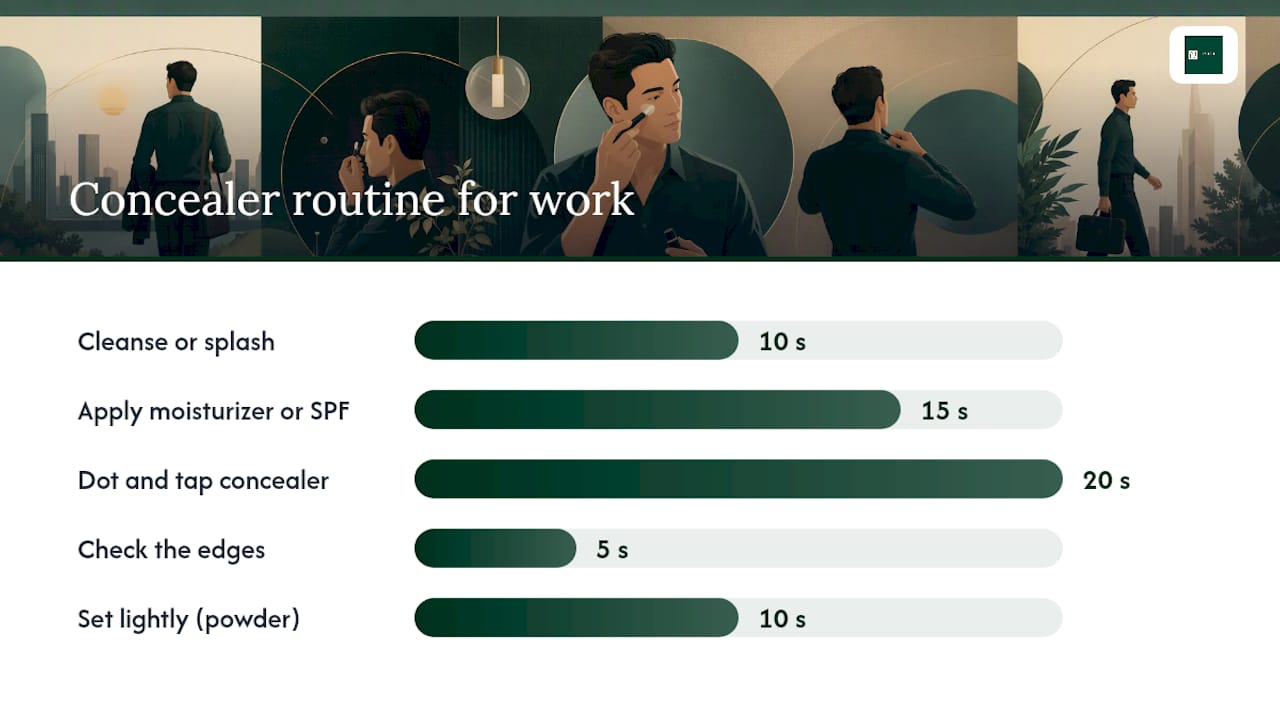
How to build a 60-second concealer routine for work
A precise sequence matters more than the amount of product you use. Follow these steps and the whole thing takes about a minute.
- Cleanse or splash with water (10 sec) — Start with a clean, dry face so the concealer grips evenly.
- Apply moisturizer or SPF (15 sec) — A thin layer of moisturizer or a lightweight SPF creates a smooth base. Let it absorb briefly before the next step. Daily skincare paired with concealer makes the finish look more natural.
- Dot concealer on target areas (10 sec) — Use the tip of your ring finger to place a small dot directly on each spot, under each eye, or along the sides of your nose.
- Tap, don’t rub (10 sec) — Press and tap the product into the skin with light, repetitive taps. Rubbing drags the product and leaves streaks.
- Check the edges (5 sec) — Run a clean fingertip along the border of any covered area to make sure there’s no visible line.
- Set lightly if needed (10 sec) — For a long workday, press a small amount of translucent powder over the concealer with a fingertip or a clean brush to lock coverage.
Pro Tip: Use your ring finger for blending — it naturally applies less pressure than your index finger, which keeps the layer thin and reduces the risk of moving the product around too much.
Beginner guides for men consistently reinforce this sequence: small amounts, careful blending, and building coverage sparingly produce the most natural finish.
Where to apply concealer in professional settings
Three zones matter most at work: under the eyes, around the nose, and on individual blemishes. Everything else is optional.
Under the eyes is the highest-impact area. Dark circles read as fatigue on camera and in person, and a thin layer of well-blended concealer neutralizes them without looking heavy. For a video call or interview, this single step makes the biggest visible difference.
Around the nostrils is where redness tends to concentrate, especially if you have any skin sensitivity. A small tap on each side of the nose evens out the tone without requiring full-face coverage.
Spot corrections on the cheeks or jawline work best with a tiny pointed brush or the tip of one finger. The goal is precision, not coverage.
Context changes what you need. A 30-minute in-person client meeting calls for less product than a full-day conference where you’re on camera repeatedly. For a job interview, a targeted concealer routine focused on under-eyes and any active blemishes is enough. For a daily office environment, you might only address one or two areas. Skip the product entirely on days when your skin looks even — less is always better than more.
How to pick the right concealer formula and shade
Shade is where most men go wrong. The instinct is to go slightly lighter under the eyes to “brighten” them, but that creates a pale patch that reads as obvious product. Makeup pros are consistent on this: match your skin tone, not lighter, and the coverage disappears into the skin.
When evaluating a formula, look for:
- Creamy, lightweight texture — thick formulas crease and look heavy; a creamy consistency blends with minimal effort
- Matte or skin-like finish — avoid luminous or dewy formulas, which catch light and draw attention
- Buildable coverage — one thin layer should be enough; buildable means you can add a second pass without it going cakey
- Fingertip-friendly consistency — if it requires a brush to blend, it’s probably too stiff for a quick routine
- A small range of shades — three flexible shades covering light, medium, and medium-deep covers most men; more options than that adds unnecessary complexity
For packaging, a small tube or stick format travels easily and applies without tools. Check the essential concealer terms if product labels like “full coverage” or “color-correcting” are confusing — those distinctions matter when you’re choosing.
Application techniques that keep concealer invisible
The difference between concealer that looks like skin and concealer that looks like product is almost always technique, not the product itself.
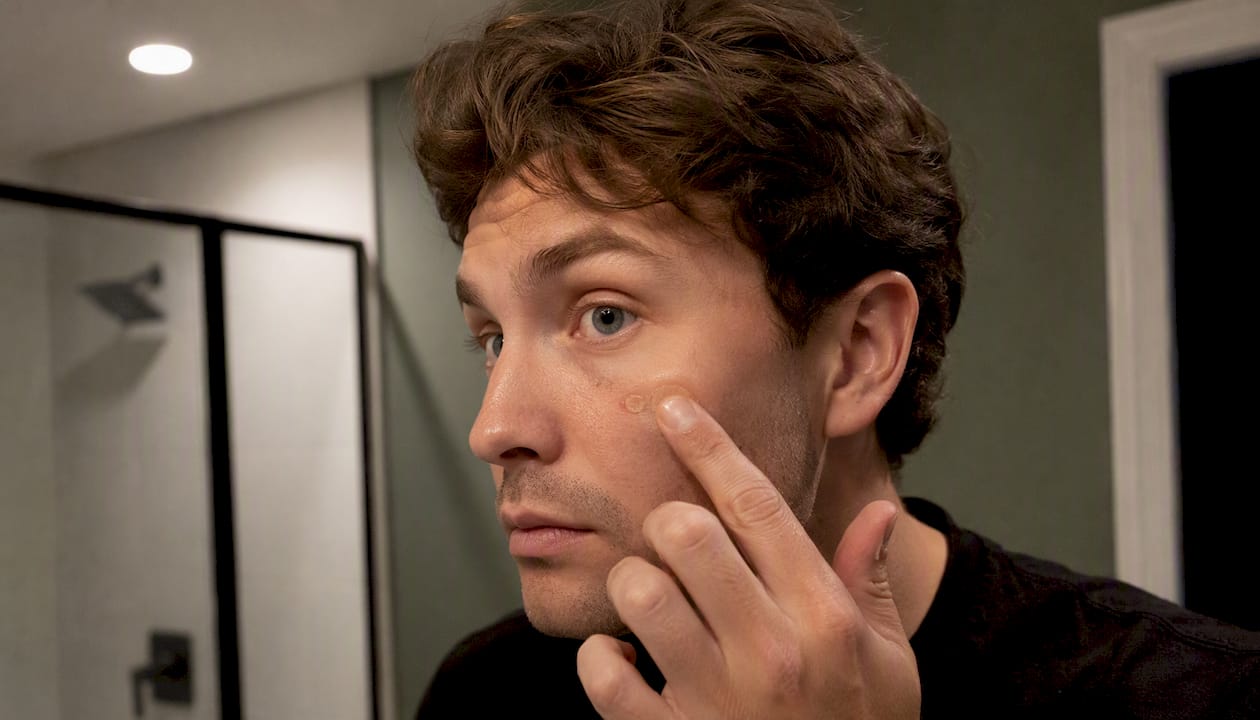
The dot-tap-thin-layer method: Place a dot of product directly on the area, then use your fingertip to tap it outward from the center. Tapping presses the product into the skin rather than sitting on top of it. Keep the layer thin — one pass is usually enough.
For a small blemish, a pointed brush gives more precision than a finger. Load a tiny amount on the tip, press it onto the spot, then blend the edges with a clean fingertip. The brush places the product; the finger blends it.
Setting for a long day: A light press of translucent powder over the concealed areas locks the product and prevents it from creasing or moving. Use a clean fingertip or a small brush, and apply the minimum amount — the goal is to set, not to add coverage. General makeup application principles support this: setting powder works best when used sparingly over an already-blended base.
Pro Tip: Before leaving the bathroom, check your face under two different light sources — natural light and overhead fluorescent. Concealer that looks invisible in warm bathroom lighting can look patchy under office LEDs. A quick 10-second check saves you from noticing it mid-meeting.
Common mistakes that make concealer obvious
Most “I can tell he’s wearing something” situations come from one of four errors.
- Too much product — the most common mistake. One small dot per area is enough. If you applied too much, blot the excess with a clean fingertip before blending.
- Wrong shade — going lighter than your skin tone creates a pale patch. If your coverage looks like a mask, the shade is off. Match your jawline or cheek, not your under-eye area.
- Rubbing instead of tapping — rubbing removes product and leaves streaks. Always tap.
- Skipping the edge check — a visible border around a covered area is the clearest sign of product. Blend outward past the edge of the coverage zone so it fades into the surrounding skin.
Quick invisibility check before you leave: no visible edges, consistent finish across the face, no color difference between covered and uncovered skin, and no shine from a luminous formula catching the light.
Why grooming at work actually changes how people see you
The evidence here is consistent. Forbes reports that well-groomed men make stronger first impressions and tend to be perceived as more competent and leadership-ready. Grooming shapes how colleagues, clients, and hiring managers read you before you say a word.
Business Insider’s reporting on corporate men’s grooming habits found that some professionals invest heavily in appearance specifically because they believe it affects how competent they appear to others. The investment doesn’t need to be expensive — a concealer used correctly takes 60 seconds and costs a fraction of what those professionals spend.
The goal isn’t to look like you tried hard. It’s to look like you always look this good. Subtle coverage supports that impression without drawing any attention to itself. That’s the role of concealer in men’s confidence: not transformation, just a cleaner version of you.
A note from Ford
Trying concealer for the first time feels awkward for about three days. Then it becomes as automatic as putting on a watch. The learning curve is real but short — one or two mornings with the 60-second routine and you’ll stop thinking about it. What you’ll notice instead is that you walk into meetings feeling sharper. That’s not a small thing.
Norml4men All-In-One Concealer fits this routine exactly
Norml4men built its All-In-One Concealer around the checklist above: fingertip-friendly texture, lightweight matte finish, and three flexible shades that cover light to medium-deep skin tones. It handles blemishes, redness, and dark circles in a single product — no separate color corrector, no brush required.

The formula is creamy enough to blend with one tap and matte enough to disappear under office lighting. Pick the shade closest to your natural skin tone, apply with your ring finger, and the routine from this article works exactly as described. Order directly at Norml4men and have it ready before your next big meeting.
Sources
- A Beginners Guide to Undetectable Men’s Makeup | Vogue
- Men in Corporate America Spend Thousands on Beauty Routines in Secret - Business Insider
- Why well‑groomed men are more successful at work | Forbes
- How to Use Concealer for Men (Beginner Guide) - Makeup For Men


