

Cover Dark Circles: A Cause-First Concealer Guide
Covering dark circles is usually worth doing. A well-matched concealer applied correctly can make you look rested, sharper, and more present in under two minutes. The catch: how well it works depends almost entirely on what’s causing the darkness in the first place.
Here’s what concealing dark circles actually does, and doesn’t do:
- What it does: Brightens the under-eye area, reduces the appearance of fatigue, and gives an immediate confidence boost with no recovery time.
- What it won’t do: Reverse deep hollows caused by bone structure, fix genetics, or treat an underlying condition.
- Quick win: A thin layer of color corrector followed by a lightweight concealer one shade lighter than your skin tone is the fastest path to a natural result.
Key Takeaways
Covering dark circles works best when the technique matches the cause. Identifying your type first, using the right corrector, and applying in thin layers produces a result that looks like skin, not makeup.
| Point | Details |
|---|---|
| Identify your type first | Vascular, pigment, and structural circles each need a different corrector and concealer approach. |
| Color correct before concealer | Peach cancels blue shadows; orange cancels deeper blue-grey; brick/red cancels purple-brown pigment. |
| Apply thin layers, stop at three-quarters | Build coverage gradually and stop short of the outer corner to avoid creasing and obvious makeup. |
| Set lightly to prevent creasing | Press translucent or pink-leaning powder sparingly; skip powder on dry or textured skin. |
| Norml4men for everyday coverage | A lightweight matte formula designed for men that covers dark circles without looking like makeup. |
Table of Contents
- Why cover dark circles? Understanding the four types first
- When is makeup enough, and when should you see a clinician?
- How to cover dark circles: a step-by-step morning routine
- How to pick a concealer that won’t look obvious
- Why a lightweight matte formula often gives the most undetectable result
- How dark circles affect how others perceive you
- Covering dark circles across different skin tones and undertones
- How lighting changes what your concealer looks like
- An honest take on covering up vs. addressing the cause
- Norml4men: lightweight coverage built for everyday use
- Sources
Why cover dark circles? Understanding the four types first
Before you reach for a concealer, a 30-second self-diagnosis saves you from buying the wrong product. Dermatologists consistently emphasize that identifying whether your darkness is vascular, pigment-based, or structural changes both the cosmetic strategy and whether a clinician visit makes sense.
A simple at-home test: gently pull the under-eye skin sideways. If the darkness lightens, you’re dealing with vascular or structural shadows. If it stays the same color, pigment is the likely cause.
| Type | Visual clues | Best cosmetic approach |
|---|---|---|
| Vascular (blue/purple) | Bluish or purplish tint; worsens with fatigue or allergies | Peach or orange color corrector, then concealer |
| Pigment (brown) | Brown or grayish tone; stays dark when skin is stretched | Red/brick corrector for deeper tones; peach for fair skin |
| Structural (hollow) | Shadowing from tear-trough depth; no color change with stretch | Brightening concealer; fillers are the clinical option |
| Puffiness/thin skin | Swelling that casts a shadow below; often worse in the morning | Cooling prep (cold compress), then light concealer |
As Mayo Clinic notes, dark circles are rarely a medical problem. Pigmentation, visible blood vessels, facial anatomy, and puffiness are the common drivers. Lifestyle steps like sleep, hydration, and sunscreen can reduce visibility over time, but they won’t erase what’s structural or genetic.
When is makeup enough, and when should you see a clinician?
Most everyday dark circles respond well to cosmetic coverage. That’s the honest answer. But a few situations call for a professional look.
See a dermatologist or physician if you notice:
- Sudden onset of darkness on one side only
- Pain, swelling, or tenderness around the eye
- Any vision changes alongside under-eye changes
- Persistent, severe pigmentation that doesn’t respond to any topical approach
For structural hollows (tear-trough shadows), color correcting won’t help because there’s no pigment to cancel. Brightening with a lighter concealer creates the illusion of volume, but the clinical path is hyaluronic acid fillers placed by a trained injector. For pigment-driven darkness, lasers and chemical peels can reduce melanin over multiple sessions. Outcomes depend heavily on the cause, so a diagnosis before committing to any procedure matters.
Lifestyle improvements like addressing seasonal allergies, improving sleep consistency, and applying SPF daily can meaningfully reduce vascular and pigment-driven circles over weeks, according to Acibadem Health Point’s clinical guidance.
How to cover dark circles: a step-by-step morning routine
This routine takes about three minutes once you’ve done it a few times. The goal is an undetectable result, not obvious coverage.
- Prep the skin. Apply a light eye cream or hydrating primer and let it absorb for 60 seconds. Skip heavy moisturizers right before makeup. They sit on the surface and cause concealer to slip within an hour.
- Color correct only where needed. Apply corrector only to the darkest area, usually the inner corner. Color theory guides the choice: peach cancels light blue shadows on fair skin, orange cancels deeper blue-grey on tan or olive skin, and red or brick tones cancel purple-brown pigment on deeper skin tones. Pat it in gently with a fingertip. Don’t rub.
- Apply concealer in a triangle shape. Draw an inverted triangle from the inner corner down toward the cheekbone, with the point facing downward. This covers the hollow and brightens the mid-face simultaneously. Use a concealer one to two shades lighter than your skin tone.
- Focus on the inner three-quarters. Makeup pros recommend stopping at roughly three-quarters of the orbital area. Taking product all the way to the outer corner causes it to settle into crow’s feet and read as obvious makeup.
- Blend with warmth, not friction. Use your ring finger (the weakest finger, which naturally applies less pressure) or a damp micro-sponge. Press and roll rather than drag.
- Set lightly. Press a small amount of translucent or pink-leaning setting powder over the concealer. Charlotte Tilbury’s technique guidance suggests waiting a moment before setting so the product warms slightly, making it easier to press away any excess before the powder locks it in.
Troubleshooting:
- Creasing after an hour: Too much product, or heavy moisturizer underneath. Start thinner.
- Cakey look: Skip the corrector if your circles are mild. One thin layer of concealer is often enough.
- Texture showing: Avoid powder on textured or dry skin. A light setting spray works better.
Pro Tip: Warm a tiny amount of concealer between your fingertip and thumb for five seconds before applying. It blends faster and sits more naturally in the skin.
How to pick a concealer that won’t look obvious
Formula matters as much as shade. The wrong texture will crease, oxidize, or sit on top of the skin rather than blending in.
Formula guidance:
- Creamy full-coverage: Best for significant pigment or vascular circles. Rich texture provides strong coverage but needs careful setting to avoid creasing.
- Lightweight radiant: Good for structural shadows where you want a brightening effect without heaviness. Works well on smooth, younger skin.
- Matte lightweight: Often the most undetectable option, particularly for men or anyone who wants a polished, skin-like finish. Reduces shine and minimizes the contrast between the concealer and surrounding skin.
| Skin concern | Recommended formula | Finish to look for |
|---|---|---|
| Dry or mature skin | Hydrating, creamy | Satin or natural |
| Oily skin | Lightweight matte | Matte |
| Fine lines or texture | Hydrating with primer | Natural or satin |
| Deep pigmentation | Full-coverage cream | Natural or satin |
Shade-testing tips:
- Test in natural light, not store lighting. Artificial light flattens color and makes shades look more neutral than they are.
- Match the corrector to the shadow color, not your skin tone.
- Apply a small triangle of concealer in the morning and check for creasing after 30 minutes before committing to a shade.
For mature or textured under-eyes, a hydrating primer applied up to the orbital area before concealer prevents product from settling into fine lines. Heavy moisturizers applied immediately before makeup tend to cause slipping rather than prevent it.
Why a lightweight matte formula often gives the most undetectable result
Shine is the enemy of undetectable coverage. A radiant or dewy concealer catches light differently than the surrounding skin, which draws attention to the under-eye area rather than blending it away. A lightweight matte formula sits flush with the skin’s surface, reducing that contrast.
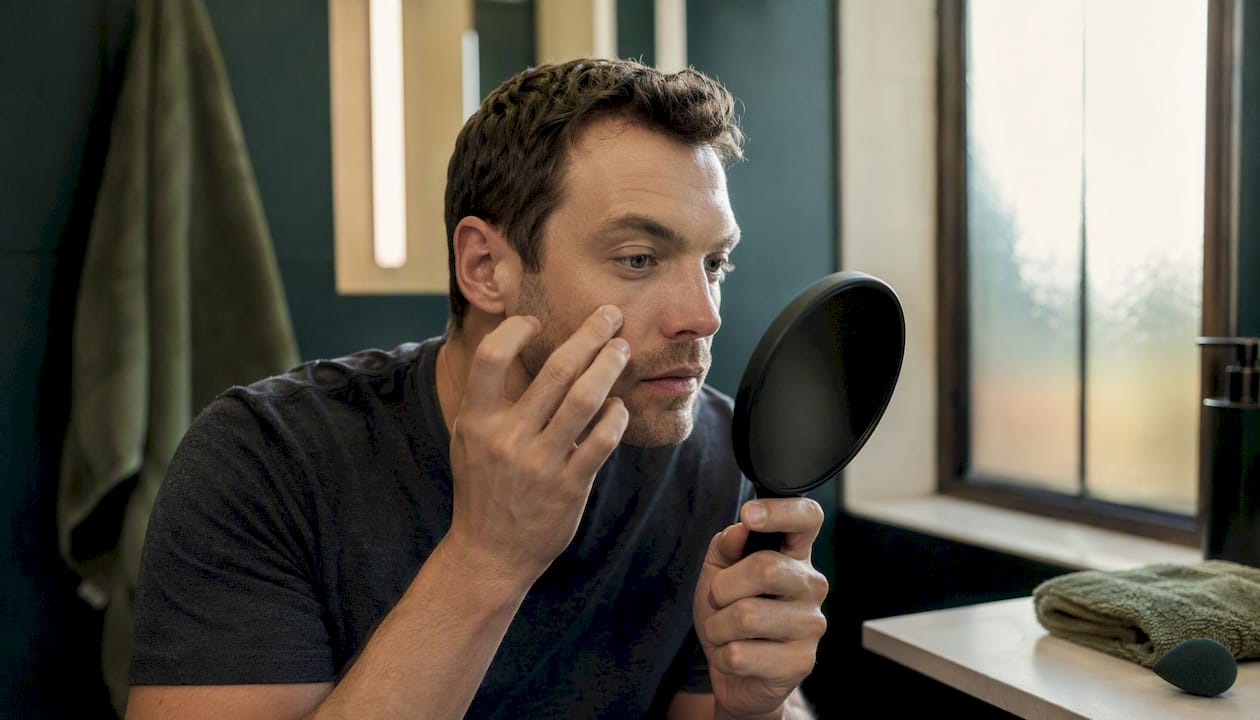
The other advantage is buildable coverage. Starting with a thin layer and adding a second pass only where needed gives you control that a heavy single application doesn’t. You avoid the cakey look that comes from trying to cover everything at once.
Norml4men’s all-in-one concealer is built around this principle: lightweight, matte, and formulated to blend into skin rather than sit on top of it. For men who want coverage without anyone noticing, the finish and weight of the formula matter more than the coverage level.
Pro Tip: For men new to concealer, apply less than you think you need. A barely-there layer that you can build on is always easier to manage than too much product that needs to be removed and restarted.
How dark circles affect how others perceive you
The psychological weight of dark circles goes beyond how you feel about your own reflection. Research in social perception consistently shows that visible under-eye darkness leads observers to rate a person as more fatigued, less healthy, and less alert, even when the person feels fine. That perception gap matters in job interviews, client meetings, and first impressions.
There’s also a feedback loop worth noting. Looking tired tends to make people treat you as though you are tired, which can subtly affect how interactions unfold. Covering dark circles doesn’t change who you are, but it can change the first read others get, and that’s a real, practical benefit.
Covering dark circles across different skin tones and undertones
The core routine stays the same regardless of skin tone, but the corrector shade and concealer undertone shift significantly.

On fair skin with blue or pink undertones, a peach corrector neutralizes the bluish shadow without adding warmth that reads orange. On medium to olive skin, an orange corrector handles the deeper blue-grey cast that peach can’t fully cancel. On deeper skin tones, where dark circles often appear as a red-brown or purple-brown pigment, a brick or red-toned corrector is the right call before a full-coverage concealer in a warm-neutral shade.
Concealer undertone matters just as much as depth. A concealer that’s the right lightness but has the wrong undertone (too pink on a warm-toned person, too yellow on a cool-toned person) will look mismatched in natural light. When in doubt, go slightly warm rather than slightly cool. Warm undertones tend to blend more naturally into most skin types and read less like makeup.
How lighting changes what your concealer looks like
Natural daylight is the most revealing light you’ll face. It shows texture, oxidation, and shade mismatches that indoor lighting hides. If your concealer looks fine at home but obvious outside, the shade or formula is the issue, not the technique.
Warm artificial light (office lighting, incandescent bulbs) softens the look of makeup and makes most concealers read more naturally. Cool fluorescent lighting, common in bathrooms and offices, can make pink-toned concealers look ashy and matte formulas look flat. If you’re applying in a bathroom with cool lighting, step into natural light for a final check before leaving.
For video calls, which compress and flatten the image, a slightly brighter concealer than you’d wear in person tends to read more naturally on screen. The camera reduces contrast, so what looks slightly light in the mirror often looks correct on camera.
An honest take on covering up vs. addressing the cause
Makeup is a fast, reversible tool. It doesn’t fix what’s underneath, and it shouldn’t have to. The most useful framing is this: concealer handles the appearance problem today while you address the underlying cause over time, whether that’s better sleep, allergy management, sun protection, or a conversation with a dermatologist.
What I’d push back on is the idea that wearing concealer is somehow less legitimate than not wearing it. Looking rested and sharp has real consequences for how people engage with you. Using a men’s concealer routine to get there is no different from using any other grooming tool. The goal is to look like yourself, just without the fatigue signal. For more on pairing skincare with concealer, the dark circle solutions guide for men covers active ingredients and daily habits worth adding alongside makeup.
Norml4men: lightweight coverage built for everyday use
If you want a concealer that covers dark circles without anyone knowing you’re wearing one, the formula has to be right from the start.

Norml4men’s all-in-one concealer is lightweight, matte, and built specifically for men’s skin. It covers dark circles, blemishes, and redness in a single thin layer, blending into the skin rather than sitting on top of it. No heavy texture, no obvious finish. Just a sharper, more even look in seconds. One honest note: makeup is cosmetic. If your dark circles are persistent, one-sided, or accompanied by other symptoms, a dermatologist visit is the right next step alongside any product.
Sources
The sources below offer dermatologist-backed guidance and professional makeup technique references for readers who want to go deeper on causes, treatments, or application methods.
- Dark circles under the eyes In-depth - Mayo Clinic
- How To Get Rid Of Under-Eye Circles in 2026, According to Dermatologists and Makeup Artists
- Color Correct Dark Circles by Skin Tone - MakeupArtistPro
- Laura Geller tips on concealing dark circles and wrinkles - Prevention
This article is general information, not a substitute for advice from a qualified doctor. Consult a qualified healthcare professional about your own circumstances before acting on anything here.


