

Subtle Enhancement for Men: What It Is and How to Do It
Subtle enhancement is a small, natural-looking improvement achieved by an undetectable men’s concealer that evens skin tone, hides blemishes, and reduces dark circles. Done right, nobody notices the product. They just notice you look sharper. The role of subtle enhancement in men’s grooming has grown significantly, and the technique itself takes under a minute once you know what you’re doing.
The visual goals are straightforward:
- Even out blotchy or red patches
- Reduce the shadow under your eyes
- Cover a blemish or spot without caking it
Pro Tip: Start with one problem area only. Under-eye coverage alone makes a bigger difference than most men expect.
Key Takeaways
Subtle enhancement works because a small amount of well-matched concealer, blended with a fingertip, is genuinely undetectable in everyday settings.
| Point | Details |
|---|---|
| Definition | Subtle enhancement means targeted concealer use that evens skin tone and hides blemishes without looking like makeup. |
| Less is more | One sesame-seed-sized dot per area is enough; adding more product creates the visible patches you’re trying to avoid. |
| Shade matching | Match to your jawline, check in natural light, and go slightly darker rather than lighter when between shades. |
| Start under the eye | Under-eye coverage gives the biggest visible payoff and is the most forgiving area to learn on. |
| Norml4men | The NORML All-in-One Concealer covers blemishes, redness, and dark circles in three shades with a fingertip-friendly matte formula. |
Table of Contents
- What does subtle enhancement actually look like?
- Why choose subtle enhancement over heavier coverage?
- What features should you look for in a concealer?
- How do you pick the right shade?
- How to apply concealer for an undetectable result
- A 60-second daily routine and how to remove it
- Common mistakes and how to fix them
- Why the Norml All-in-One Concealer is built for this
- The case for starting simple
- One product that covers it all
- Sources
What does subtle enhancement actually look like?
The finished look is simple: you look rested, even-toned, and put-together. Nobody can point to a specific product on your face. According to AgeFresh, targeted, sparing use of light cosmetics reads as “rested and healthy” rather than “wearing makeup.” That’s the entire goal.
Think about a Monday morning meeting, a first date, or a video call where the lighting is unflattering. In each of those situations, a small reduction in under-eye shadow or a covered blemish shifts how people read your face. They don’t think “he’s wearing concealer.” They think “he looks like he slept well.” You can see natural makeup looks for men that demonstrate exactly this effect.
Facial massage and consistent skincare can also improve baseline skin tone over time, which makes subtle enhancement even easier to pull off. The science behind facial massage and skin tone is worth a look if you want to complement what concealer does.
Why choose subtle enhancement over heavier coverage?
Speed is the first reason. A fingertip application to two or three spots takes 45 seconds. A full-coverage routine takes considerably longer and requires more skill to look natural.
The second reason is social friction. Heavy coverage on men still reads as obvious to most people in close-range settings. Light, targeted coverage doesn’t. Concealer use tied to confidence works precisely because the result is discreet. You feel better without having to explain anything.
The third reason is practicality. Subtle enhancement handles the most common visible concerns: tired-looking eyes, a red patch, a single blemish. It’s not the right tool for full-face coverage, stage makeup, or high-definition photography. For those situations, you’d need a heavier formula and more technique. For everyday life, light and targeted wins.
What features should you look for in a concealer?
Not every concealer formula works for subtle enhancement. Here’s what actually matters:
- Coverage level: Light-to-medium. You want to be able to layer it without it looking cakey. Heavy, full-coverage formulas are harder to blend invisibly.
- Finish: Natural matte. A sheen or dewy finish catches light and draws attention. Matte disappears.
- Texture: Creamy and blendable. If it drags or sits stiff on the skin, it won’t blend with a fingertip.
- Shade range: A small, flexible range with clear undertone guidance. You don’t need 40 shades. You need three or four well-chosen ones.
- Packaging: Fingertip-friendly. Tubes and small compacts work. Anything that requires a brush to dispense adds steps.
Vogue’s beginner guide to men’s makeup recommends using a creamy, easy-to-blend concealer only where needed and matching the shade to your skin tone. That’s the formula. Anything more complicated than that is more than you need.
Pro Tip: Avoid formulas marketed for “full coverage” or “high definition.” They’re built for photography, not for looking natural in person.
How do you pick the right shade?
Shade matching is where most men go wrong. The instinct is to go lighter under the eyes to “brighten” them. That usually backfires. A too-light concealer creates a pale triangle that’s more obvious than the dark circle it was meant to cover.
The better approach:
- Match to your jawline or cheek, not your under-eye area
- Choose the shade closest to your actual skin tone
- If you’re between two shades, go slightly darker rather than lighter
- Check in natural light, not bathroom lighting, which skews warm
Norml4men’s shade guidance makes the same point: a slightly darker match is often less detectable than one that’s too pale. Visible lines and patches almost always come from over-application or a shade that’s too light.
For undertones: peach or salmon tones help neutralize blue or purple under-eye shadows. Yellow tones work on brown pigmentation. Green corrector handles redness, though use it sparingly and only as a base layer under your concealer.
Pro Tip: Apply a small amount to your jawline, wait 30–60 seconds, then check in natural light. If it disappears, that’s your shade.
How to apply concealer for an undetectable result
This is a five-step process that takes about 90 seconds the first few times and closer to 45 seconds once it’s muscle memory. Beginner guidance from Makeup For Men confirms the core method: small amount, targeted placement, gentle blending.
- Prep your face. Clean skin, then moisturizer if you use one. Let it settle for 30 seconds before applying concealer on top.
- Dispense a tiny amount. Smaller than you think. A dot the size of a sesame seed covers one under-eye area. Warm it between your fingertips for two seconds before applying.
- Place it precisely. Under the eye, dab in a small triangle from the inner corner outward. On a blemish, press a single dot directly on the spot. For redness around the nose, tap lightly around the affected area.
- Blend outward. Pat and tap with your fingertip. Never drag or rub. Work from the center of the coverage outward until the edges disappear into the surrounding skin.
- Layer only if needed. One thin layer is almost always enough. If you need more, add a second thin layer after the first sets. On oily skin, a light press of translucent powder over the top extends wear.
The Norml4men application guide reinforces the pat-don’t-rub rule. Dragging moves the product off the target area and creates visible edges.
Pro Tip: Warm the product on your fingertip before applying. It blends faster and looks more natural than applying it cold.
A 60-second daily routine and how to remove it
The whole thing fits inside a minute once you’re practiced:
- 0–20 seconds: Moisturizer if you use one. Let it absorb briefly.
- 20–45 seconds: Apply concealer to your two or three trouble spots using the fingertip method above.
- 45–60 seconds: Blend edges, set with translucent powder if your skin runs oily.
Midday touch-ups are rarely needed with a light application. If you’re in a hot environment or your skin is oily, a quick press with a clean fingertip can re-blend any areas that have shifted.
At night, a gentle cleanser or micellar water removes it completely. Follow with your usual moisturizer. The men’s beginner makeup guide recommends keeping removal as simple as the application itself.
Pro Tip: Micellar water on a cotton pad removes light concealer in one swipe. No scrubbing needed.
Common mistakes and how to fix them
Too much product is the most common problem. Fix it by pressing a clean fingertip or damp sponge gently over the area to absorb the excess, then re-blend. Don’t add more product to fix a heavy application.
Wrong shade shows up as a visible patch. If it’s too light, blend the edges outward as far as possible and layer a tinted moisturizer over the top to bring it closer to your skin tone. If it’s too dark, blend more aggressively and avoid covering the entire area.
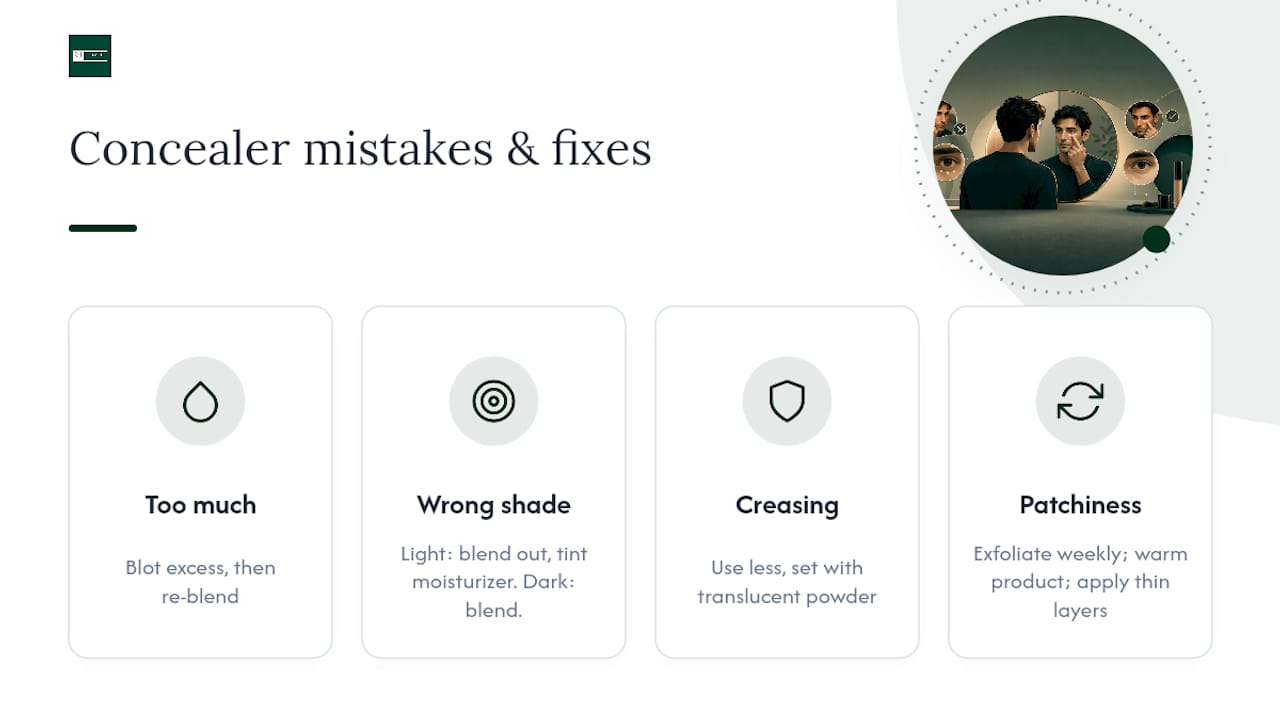
Creasing under the eye usually means too much product in a fine-line area. Use less, set lightly with translucent powder, and consider applying a thin hydrating eye cream before concealer to give it a smoother base.
Patchiness often comes from dry or uneven skin texture. Exfoliate once or twice a week, use thin layers, and always warm the product between your fingers before applying.
Why the Norml All-in-One Concealer is built for this
The Norml All-in-One Concealer for Men was designed specifically around the subtle enhancement approach described in this guide. It checks every box from the product features section:
- Lightweight, matte finish that reads as natural skin
- Creamy, blendable texture that works with a fingertip
- Three flexible shades with clear guidance on which to choose
- Covers blemishes, redness, and dark circles in one product
- No brush required
The formula is light enough that one small dot covers a blemish without building up. For under-eye use, a tiny amount warmed on the fingertip and patted into the triangle below the eye blends in about 15 seconds.
The case for starting simple
There’s a version of men’s grooming that gets complicated fast. More products, more steps, more things to get wrong. Subtle enhancement pushes back against that. The whole point is one product, two or three spots, under a minute.
Most men who try concealer for the first time are surprised by two things: how little product it takes, and how quickly they stop thinking about it. Under-eye coverage is the best starting point because it’s the most forgiving area to apply and the most visible payoff. Start there. Get comfortable. Add a spot or two if you want.

The social reality is that nobody is scrutinizing your face that closely. When the result is a natural matte finish that matches your skin tone, the only thing anyone notices is that you look like you got a decent night’s sleep.
One product that covers it all
Sharp skin in under a minute is exactly what Norml4men built the NORML All-in-One Concealer for. One product, three shades, fingertip application, lightweight matte finish. No kit, no brushes, no routine overhaul.

The formula covers blemishes, redness, and dark circles in a single step, which cuts the decision-making out of your morning entirely. If you’re new to concealer, start with the shade closest to your jawline tone. Apply a dot, blend it out, and you’re done. Check the natural finish guide for shade-matching help if you’re unsure which of the three to pick. Order at norml4men.com and test your shade in natural light the first morning you use it.
Sources
- A Beginners Guide to Undetectable Men’s Makeup | Vogue
- Concealer and Light Cosmetics for Adult Men · AgeFresh
- How to Use Concealer for Men (Beginner Guide) - Makeup For Men


