

Understanding Makeup Stigma for Men in 2026
TL;DR:
- The stigma around men using makeup originated in the Victorian era, enforcing harmful gender norms.
- Changing societal attitudes, economic growth, and social media normalization are gradually breaking down these outdated beliefs.
Most men who reach for a concealer on a rough morning aren’t making a political statement. They just want to look like they slept. But society views on men wearing makeup have historically made even that small act feel loaded with judgment, risk, and identity questions most guys never signed up to answer. Understanding makeup stigma for men means looking past the surface reaction and into the deep cultural machinery that decided, roughly 150 years ago, that cosmetics were strictly women’s territory. That machine is breaking down. And knowing exactly how it was built is the fastest way to stop letting it run your decisions.
Table of Contents
- Key takeaways
- Understanding makeup stigma for men: where it actually starts
- What’s actually changing right now
- The myths that keep the stigma alive
- How to actually start without the drama
- How culture shapes what feels acceptable
- My take: the stigma is real but it’s not about you
- Look better in the next five minutes
- FAQ
Key takeaways
| Point | Details |
|---|---|
| Stigma has a specific origin | The stigma around men and makeup is a Victorian-era invention, not a timeless truth. |
| Economics are driving change | Global men’s grooming sales are projected to top $85 billion by 2032, proving this shift is real and lasting. |
| Subtlety is the practical entry point | Starting with one product that corrects without covering gives you the results without the visibility. |
| Culture shapes perception | Acceptance of male makeup varies widely across cultures and generations, especially among Gen Z. |
| Reframing is the key move | Treating makeup as maintenance rather than vanity removes most of the psychological friction. |
Understanding makeup stigma for men: where it actually starts
Before makeup became “a women’s thing,” it wasn’t. Ancient Egyptian men lined their eyes with kohl. Roman men used lead-based powders to even their complexions. For most of human history, cosmetics were tools of status and power, and gender had very little to do with it.
The hard turn came in the 19th century. The Victorian era cemented a rigid gender binary that tied cosmetics directly to femininity and, worse, to moral weakness. A man who wore powder was considered effeminate or morally suspect. A woman who wore rouge was barely respectable. Everyone lost, but men got handed a specific version of the deal: appear natural or appear untrustworthy. That framing stuck.
There were cracks in the wall, of course. Hollywood in the 1920s and 1930s had male stars wearing full foundation under studio lights, though nobody called it makeup. Glam rock in the 1970s put David Bowie and Marc Bolan in eyeliner on magazine covers, but that was explicitly framed as transgression, not mainstream behavior. The takeaway from both moments matters: makeup on men was tolerated when it served a performance or a rebellion, never when it served an ordinary Tuesday morning.
“The stigma didn’t emerge from biology or ancient tradition. It was constructed in a specific historical moment to enforce a specific idea of what a man should look like. That means it can be unconstructed.”
That framing is where breaking gender beauty norms actually begins — not with a bold statement, but with knowing the stigma was always a choice someone else made for you.
What’s actually changing right now
The forces reshaping male makeup trends aren’t coming from one direction. They’re economic, generational, and technological, all hitting at the same time.
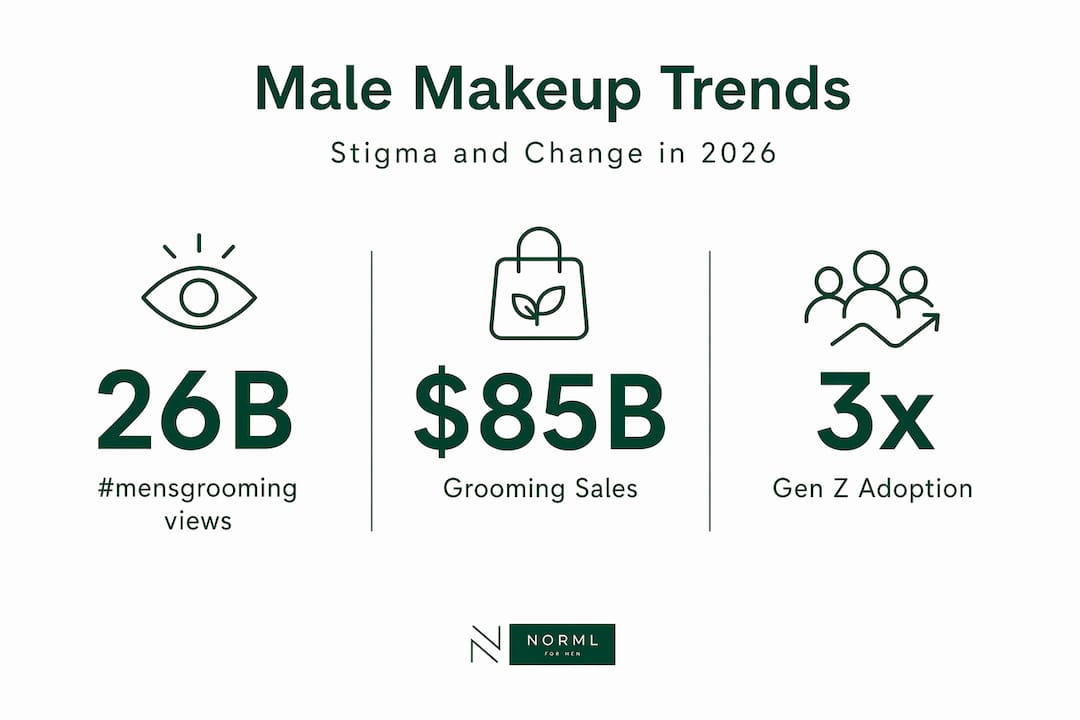
Start with the numbers. Men’s grooming sales are projected to exceed $85 billion by 2032, driven largely by Gen Z normalizing cosmetics across gender lines. That isn’t activist momentum. That’s consumer behavior, which means brands, retailers, and product developers are actively investing in making this space more accessible. When Sephora and Ulta start dedicating shelf space to male-positioned grooming products, the infrastructure of stigma starts to crumble.
Social media accelerated the timeline dramatically. The #mensgrooming hashtag crossed 26 billion views on TikTok, turning what used to be a niche conversation into a mainstream reference point. Younger men watching tutorials on how to conceal dark circles or reduce redness aren’t viewing it as transgressive. They’re viewing it as useful.
Here’s a shift that gets underreported: remote work and video conferencing changed the appearance calculus for men in professional settings. When your face is 18 inches wide on a colleague’s screen for six hours a day, redness, dark circles, and uneven skin tone become visible in ways they weren’t in a conference room. Makeup use for men is increasingly tied to professional competitiveness, not just personal preference.
| Driver | What it looks like in practice |
|---|---|
| Economic growth | Retailers expanding men’s beauty sections, new product lines launching regularly |
| Social media normalization | TikTok tutorials making technique accessible to beginners without shame |
| Video conferencing | On-screen visibility creating practical demand for skin-evening products |
| Generational shift | Gen Z treating cosmetics as gender-neutral by default |
Pro Tip: If you’re new to this and not sure where to start, look at products that describe results rather than products that call themselves “men’s makeup.” Functional language removes the psychological barrier before you even open the jar.
The myths that keep the stigma alive
Knowing why stigma exists historically is one thing. Understanding the specific beliefs that maintain it day-to-day is where the real work happens.
The biggest myth is the equation between makeup and femininity. Society views on men wearing makeup through a lens that treats anything cosmetic as inherently female, which then gets connected to sexual identity, vanity, or insecurity. None of those connections are logical, but they’re socially reinforced constantly, through comments, humor, and the absence of male representation in mainstream beauty advertising.
The second layer is the masculinity ideal. The version of male toughness that dominates Western culture is built on “naturalness.” The idea that a real man doesn’t need help with his appearance, that needing to look better is a form of weakness. That narrative does real damage because it isn’t just about makeup. It extends to asking for directions, going to therapy, or admitting you’re tired. Makeup becomes a proxy for a much larger conversation about male vulnerability.
Here’s what actually happens when men navigate this terrain:
- Passing: Many men who use concealer do so in ways no one detects, essentially choosing invisibility over identity confrontation.
- Avoidance: Some men who would benefit from a simple product skip it entirely because the social cost of discovery feels too high.
- Rejection: A growing group, particularly younger men and those connected to LGBTQ+ communities, are rejecting the stigma actively and building social environments where makeup is simply not a controversy.
The third myth worth naming: that wearing makeup means you’re trying to look like someone else. Most men who use concealer or tinted moisturizer aren’t trying to transform. They want to look like themselves on a good day, and that’s a completely reasonable goal.
How to actually start without the drama
The practical barrier for most men isn’t philosophical. It’s “I don’t know what to buy or how to use it without looking like I tried too hard.” That’s solvable.
- Start with skin prep. Undetectable results come 80% from preparation and 20% from the product itself. Moisturized, clean skin blends anything better.
- Pick one high-impact product. Starting with a single product like a tinted moisturizer or under-eye brightener gives you a result without a routine.
- Match your skin tone, not a formula. The best results for men come from redness correction and natural tone matching, not full-coverage foundation.
- Avoid gendered labels. The most effective brands don’t call their products “men’s makeup.” They focus on what the product does, not who’s supposed to use it.
- Use supportive spaces to learn. Online communities, tutorials, and forums remove the awkwardness of learning in public. You don’t have to figure this out alone.
Pro Tip: Think of your concealer the same way you think of a wrinkle-free shirt or a good haircut. It’s maintenance. It makes you look sharper without anyone knowing why. That reframe alone removes most of the internal resistance.
The men’s beginner makeup guide at Norml4men is a solid starting point if you want step-by-step guidance built specifically around natural, undetectable looks.
How culture shapes what feels acceptable
Why do men wear makeup in South Korea without a second thought, while the same behavior in a mid-size American city invites commentary? Because why do men wear makeup isn’t a universal question with a universal answer. It’s a culturally specific one.

In South Korea, the skincare and grooming market for men has been mainstream for decades. Male celebrities openly endorse BB creams and skin products. The behavior is normalized not because Korean masculinity is “softer” but because the cultural script around male appearance was written differently there.
In Western contexts, cultural attitudes vary widely, with male makeup most accepted in LGBTQ+ communities and creative industries, and most stigmatized in traditional professional or rural environments. That isn’t fixed. It’s shifting, particularly among men under 30 who grew up seeing beauty content that never assumed gender.
A few dynamics worth tracking:
- The “clean skin” minimal look has reduced the barrier to entry for men who want even skin tone without anything that reads as costume or statement.
- Maximalist male makeup, full coverage and deliberate color, is simultaneously challenging masculinity norms at the fashion and cultural level.
- The LGBTQ+ community has always functioned as the leading edge of this conversation, creating spaces where experimentation was safe long before mainstream culture caught up.
Masculinity isn’t a fixed object. It’s a set of agreements, and agreements can be renegotiated. The generation currently in their 20s is doing exactly that.
My take: the stigma is real but it’s not about you
From where I stand, the most honest thing I can say about understanding makeup stigma for men is this: the stigma is real, but it was never really about you. It’s about a cultural framework that decided, 150 years ago, what a man should look like and then spent a century enforcing that decision through humor, silence, and social pressure.
What I’ve noticed, watching this conversation evolve, is that the men who navigate it best aren’t the ones who make a public statement about it. They’re the ones who quietly decide the rule doesn’t apply to them and then get on with their day. There’s no dramatic confrontation, no justification required. They look better. They feel more confident. Nobody notices the product. That’s the actual win.
The harder work is the internal one. Redefining what maintenance means for you, separating appearance from vanity, and recognizing that wanting to look your best is not a personality flaw. That confidence and appearance are connected isn’t a vanity claim. It’s documented.
The stigma will keep shrinking. But you don’t have to wait for society to fully catch up before you decide it doesn’t have power over you.
— Ford
Look better in the next five minutes
If this article got you thinking about actually trying something, Norml4men built a product specifically for exactly this situation.
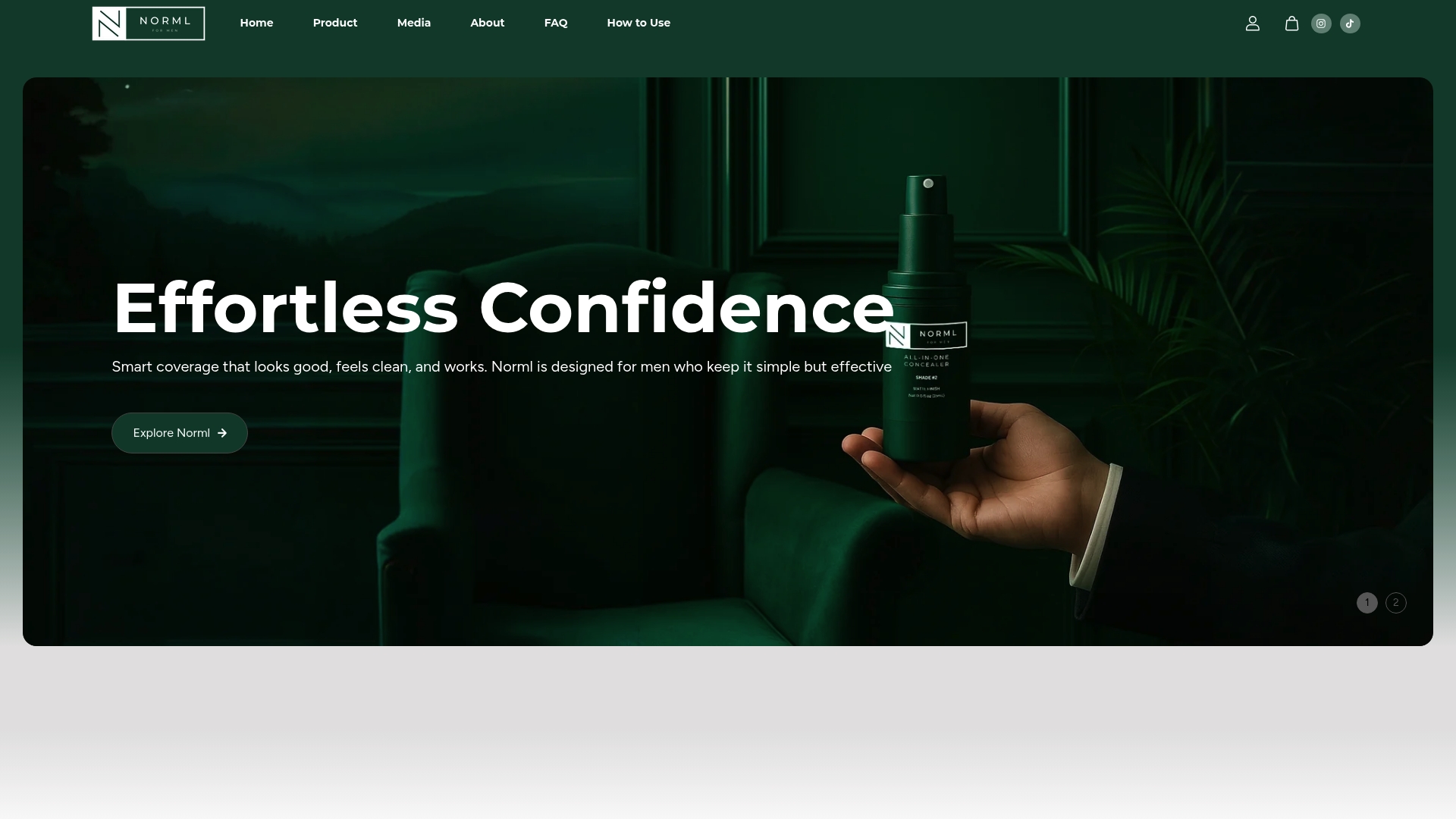
The Norml All-In-One Concealer is lightweight, matte, and formulated to match men’s skin tones rather than defaulting to the pink undertones that make most concealers look obvious. It covers redness, blemishes, and dark circles in seconds, and it’s specifically designed so that nobody can tell you’re wearing anything. No learning curve. No dramatic change. Just you, looking like you on your best day. It’s a practical tool, not a statement. That’s the entire point of Norml4men.
FAQ
What is makeup stigma for men?
Makeup stigma for men is the social pressure and negative judgment men face when they use cosmetic products, rooted in Victorian-era gender norms that equated makeup exclusively with femininity.
Why do men wear makeup despite the stigma?
Men wear makeup primarily for practical reasons, including covering blemishes, reducing redness, and looking sharper in professional or social settings, with most preferring undetectable, natural-finish products.
How is social media changing how society views men wearing makeup?
The #mensgrooming hashtag alone has surpassed 26 billion views on TikTok, normalizing male makeup use among younger generations and making tutorials and product knowledge widely accessible.
What products work best for men new to makeup?
Starting with a single skin-tone-matched concealer or tinted moisturizer is the most effective approach, prioritizing redness correction and natural finish over full-coverage products that can look artificial.
Does male makeup use differ across cultures?
Yes. Countries like South Korea have mainstream male grooming markets where cosmetic use is unremarkable, while Western attitudes vary widely by region, generation, and community, with acceptance growing consistently among men under 30.


