

Men vs. women cosmetics: what makes the difference?
TL;DR:
- Men’s skin is thicker and oilier, requiring different cosmetic formulations for optimal results.
- Choosing products tailored to men’s biology improves absorption, reduces irritation, and enhances appearance.
- Cultural perceptions are shifting, making men’s grooming and cosmetic use more normalized and purposeful.
Men’s skin is up to 25% thicker than women’s, yet the cosmetics industry has spent decades designing most products with women in mind. That’s not a complaint, it’s just a fact worth understanding. If you’ve ever grabbed a moisturizer off a shelf without thinking twice about who it was made for, you’re not alone. But here’s the thing: using the wrong formulation for your skin type can mean wasted money, breakouts, or a finish that just doesn’t look right. This guide breaks down the real physical, formulation, cultural, and practical differences between men’s and women’s cosmetics so you can make smarter choices every time.
Table of Contents
- The science behind skin differences
- Formulation and ingredient variations
- Cosmetics use and cultural perceptions
- How to choose cosmetics for your skin type
- What most guides miss about men’s cosmetics
- Discover men’s cosmetic solutions from Norml
- Frequently asked questions
Key Takeaways
| Point | Details |
|---|---|
| Skin matters most | Men and women have fundamentally different skin types, affecting cosmetic needs. |
| Formulation counts | Ingredients and textures are adjusted for men’s skin, so using the right product is vital. |
| Culture influences choices | Societal perceptions impact what products are seen as acceptable for men versus women. |
| Practical selection tips | Choosing cosmetics according to your skin type and preferences yields the best results. |
The science behind skin differences
Before you can understand why men’s and women’s cosmetics differ, you need to understand what’s actually going on with your skin. The differences aren’t just marketing spin. They’re rooted in biology, and they have a direct impact on how products perform.
Men’s skin is often thicker, oilier, and subject to different aging patterns than women’s skin. That extra thickness comes from higher levels of collagen density and testosterone-driven structural changes. It means your skin can handle heavier ingredients in some ways, but it also means that lightweight, fast-absorbing formulas tend to work better day-to-day because heavy creams can sit on the surface and clog pores.
Here are the core physical differences that matter most:
- Thickness: Men’s skin is roughly 20 to 25 percent thicker due to higher collagen content, which affects how products absorb.
- Oil production: Men produce significantly more sebum, which leads to larger pores and a higher baseline shine level.
- Aging patterns: Men tend to age more slowly early on but experience more dramatic changes after 50, particularly around the jawline and eyes.
- Hair follicles: Men have more active follicles across the face, which changes how products spread and settle.
- pH levels: Men’s skin tends to be slightly more acidic, which influences how certain active ingredients react.
These aren’t minor details. They shape everything from how a moisturizer absorbs to whether a concealer oxidizes and turns orange on your skin. One of the most common mistakes men make is reaching for a women’s anti-aging cream and wondering why it feels greasy or pills under their stubble. It’s not that the product is bad. It’s just not built for your skin’s structure.
Understanding why men’s cosmetics differ from women’s gives you a real advantage when shopping. You stop guessing and start selecting. And if you’re dealing with specific issues like persistent redness or under-eye shadows, knowing your skin’s biology helps you target the right solution. Products designed around common skin concerns in men are built with these biological realities in mind, which is why they tend to deliver better results.
Formulation and ingredient variations
Once you understand the physical differences, the ingredient choices start making a lot more sense. Cosmetic chemists don’t just swap out a label when making a men’s product. They rethink the entire formula.
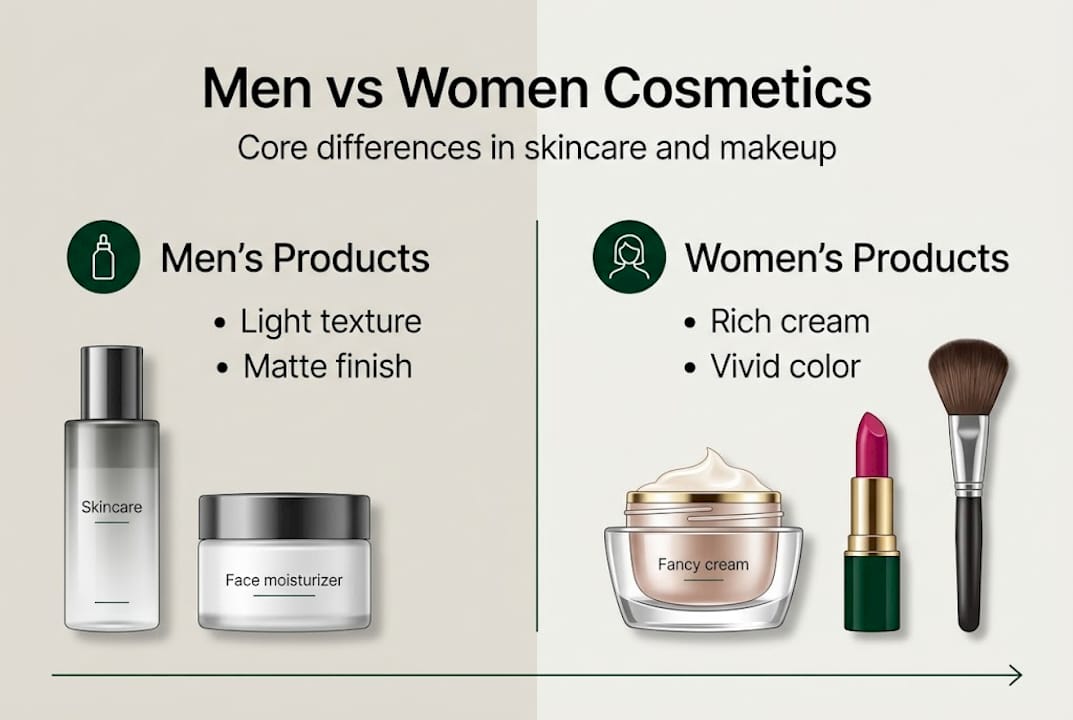
Cosmetic formulations for men often include lighter textures, less fragrance, and different active ingredients compared to women’s products. This isn’t about preference. It’s about performance. Lighter textures absorb faster into thicker skin. Less fragrance reduces irritation, especially important for men who shave regularly and have a compromised skin barrier on most mornings.

Here’s a quick comparison of how formulations typically differ:
| Feature | Men’s formulations | Women’s formulations |
|---|---|---|
| Texture | Lighter, gel-based | Richer, cream-based |
| Fragrance | Minimal or musk-based | More complex, floral |
| Active ingredients | Salicylic acid, niacinamide | Retinol, hyaluronic acid |
| Finish | Matte | Dewy or satin |
| Absorption speed | Fast | Moderate |
The matte finish point is especially relevant for cosmetics like concealers or tinted moisturizers. Men’s skin already produces more oil, so a dewy finish product will amplify shine within an hour of application. A matte formula keeps things looking clean and natural without the “wet” look that gives away that you’re wearing something.
Pro Tip: If you’re trying a new product and it feels heavy or looks shiny within 30 minutes, it’s likely formulated for a different skin type. Swap to a gel or matte version and you’ll notice the difference immediately.
Ingredient safety is another angle worth thinking about. Men who shave daily are introducing micro-cuts to the skin surface regularly. This makes the skin more reactive to certain preservatives and fragrances found in women’s products. Products designed for men often reduce or eliminate these irritants to keep the skin barrier intact. Exploring demystifying men’s cosmetics can help you decode labels and understand what you’re actually putting on your face.
Cosmetics use and cultural perceptions
The biology is one thing. The culture around men’s cosmetics is a whole other conversation, and it’s shifting fast.
For most of the 20th century, the idea of men using cosmetics beyond basic grooming was considered unusual in Western culture. That’s changed significantly. Men’s skincare and makeup leads to real increases in confidence, and more men are acting on that. The stigma is fading, and the product options are expanding to match.
Here’s how product usage typically breaks down by category:
| Product category | Common among women | Growing among men |
|---|---|---|
| Moisturizer | Yes | Yes |
| Concealer | Yes | Yes |
| Foundation | Yes | Increasingly |
| Sunscreen | Yes | Yes |
| Tinted products | Yes | Growing |
The numbers tell a clear story. The men’s grooming market has grown into a multi-billion dollar industry globally, and a big driver of that growth is men realizing that looking after their skin and appearance isn’t a compromise. It’s a practical decision.
Marketing plays a huge role here. Women’s cosmetics are typically sold around transformation and beauty ideals. Men’s cosmetics are increasingly sold around performance, confidence, and simplicity. That framing matters because it changes how men approach the products. You’re not buying a look. You’re solving a problem.
Here’s how cultural perceptions have shifted in practical terms:
- Normalization of skincare: Basic moisturizing and SPF use is now mainstream for men across age groups.
- Concealer adoption: More men are using concealers to cover blemishes and dark circles before important meetings or events.
- Tinted products: BB creams and tinted moisturizers designed for men are growing in popularity because they offer coverage without the appearance of wearing makeup.
- Social media influence: Platforms like TikTok and Instagram have made men’s grooming content highly visible, reducing the perceived barrier to entry.
“The shift isn’t about men wearing makeup. It’s about men using tools that help them look and feel their best, just like they would with a great haircut or a well-fitted shirt.”
Exploring men’s skincare vs makeup shows how the line between the two is blurring in a way that benefits men who want practical, low-effort results. And understanding the role of facial cosmetics for men helps clarify that this isn’t about aesthetics alone. It’s about showing up as the best version of yourself.
How to choose cosmetics for your skin type
Knowing the differences is useful. Knowing how to apply that knowledge when you’re standing in front of a shelf or scrolling through products online is what actually changes your routine.
Men benefit from selecting products tailored to their skin type rather than defaulting to whatever’s available or borrowing from a partner’s collection. The starting point is always your skin type.
Here’s what to ask yourself before buying any cosmetic product:
- Is my skin oily, dry, combination, or sensitive? This determines texture and ingredient priorities.
- What problem am I trying to solve? Redness, dark circles, blemishes, and uneven tone all need different solutions.
- Do I have any known ingredient sensitivities? Fragrances, alcohol, and certain preservatives are common irritants.
- What finish do I want? Matte works for most men. Dewy can look unnatural on oily skin.
- How much time am I willing to spend? Be honest. A five-step routine you abandon in a week is worse than a one-step routine you stick with.
Reading labels is a skill worth developing. Look for products that list key actives early in the ingredient list, since ingredients are listed in order of concentration. If a men’s concealer lists niacinamide or zinc in the first five ingredients, it’s genuinely formulated to address oiliness and redness. If it lists fragrance or alcohol near the top, it may cause irritation over time.
Pro Tip: Start with one product and use it consistently for two weeks before adding another. This way, if your skin reacts, you know exactly what caused it.
Building a routine doesn’t have to be complicated. A cleanser, a lightweight moisturizer with SPF, and a targeted concealer for problem areas covers most men’s needs. Understanding how the role of facial cosmetics fits into daily life makes it easier to commit. And learning how skincare shapes men’s appearance over time gives you a long-term reason to stay consistent.
What most guides miss about men’s cosmetics
Here’s the honest take: the cosmetics industry separates products by gender partly because it makes biological sense, and partly because it makes marketing sense. Those two motivations don’t always point in the same direction.
Your skin is individual. Two men with the same gender label can have completely different skin types, concerns, and reactions to ingredients. The gender category on a label is a starting point, not a rule. If a product formulated for women works better for your dry skin than anything in the men’s section, use it. The goal is results, not category compliance.
What we’ve seen is that men who get the best outcomes are the ones who treat cosmetics like any other practical tool. They test, they adjust, and they don’t overthink the label. The industry is catching up, and men’s cosmetic solutions are getting better and more targeted every year. But the mindset shift, from “this isn’t for me” to “what actually works for my skin,” is the real unlock.
Discover men’s cosmetic solutions from Norml
If you’ve made it this far, you already think more clearly about cosmetics than most men do. Now it’s time to put that knowledge to work.

Norml was built specifically for men who want to look sharper without spending 20 minutes in front of a mirror or explaining what they’re wearing. The all-in-one men’s concealer covers blemishes, redness, and dark circles instantly, with a matte finish that blends into your skin and stays invisible all day. No cakey finish. No obvious coverage. Just a cleaner, more even look in seconds. If you’re ready to see what a product actually built for your skin can do, explore Norml for Men and find the right fit for your routine.
Frequently asked questions
Are men’s cosmetics really different from women’s?
Yes, men’s cosmetics are formulated to match thicker, oilier skin and different grooming needs. Men’s skin is often thicker and oilier than women’s, which directly affects how ingredients absorb and perform.
Can men use women’s cosmetics safely?
Men can use women’s cosmetics without safety concerns in most cases, but the results are often suboptimal. Men benefit from products tailored to their skin type rather than formulas designed for different oil levels and skin thickness.
What products should men start with if new to cosmetics?
Start with a lightweight moisturizer, a broad-spectrum sunscreen, and a concealer made for men’s skin. Cosmetic formulations for men typically include lighter textures and fewer irritants, making them easier to work into a simple daily routine.


